
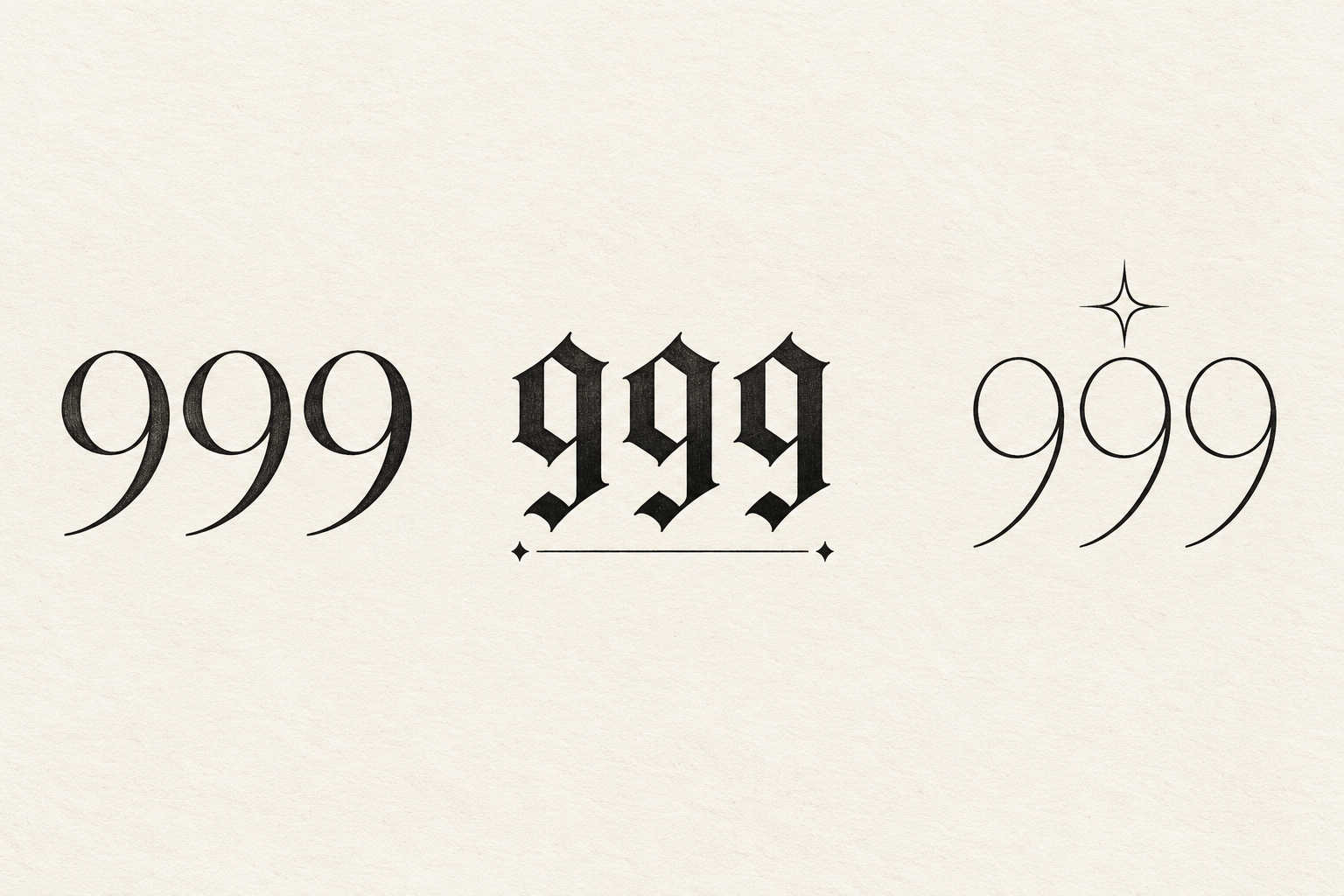
Rotate three handwritten nines and you may see three sixes. That visual reversal is part of the 999 tattoo meaning associated with Juice WRLD: turning a difficult experience toward something positive. Other people choose 999 through contemporary angel-number beliefs about completing a chapter, or because the number belongs to their own life. Those reasons can overlap, but they do not describe everyone wearing the digits.
The most useful starting point is to choose your reference. Is this a music tribute, a reminder of a decision, or a spiritual symbol? Then check that the actual lettering still reads the way you intend when your body moves.
The cover contains AI-generated lettering concepts, not examples of completed tattoo work. Numerals in any generated concept need to be checked individually.
The Juice WRLD connection has a traceable source
In an original LEADERS interview, Carmela Wallace explains her son's use of 999 as a reversal of 666 and a way of turning difficulties around. She also connects that idea with the foundation's name. That family account supports the positive-inversion explanation without requiring a tattoo website to speak for him. Read Wallace's interview about Live Free 999.
The Live Free 999 organization describes its work in mental health and substance dependency, and identifies Wallace as its founder in honor of Juice WRLD. A tattoo can express a fan's connection with that message. It does not provide treatment or establish the wearer's health history.
If you are planning a tribute, be specific about what you are remembering. You might choose the plain number because a particular listening period mattered to you, or because his message accompanied an important change. You do not need copied lyrics, a portrait, album artwork and several dates to make the reference legitimate.
For example, three simple nines with a small separate date can keep the number central while recording when the music entered your life. Leave the reason for the date in your own notes if you prefer. Its role should remain clear to you even when no caption accompanies the tattoo.
A new chapter is a personal reading, too
Numerology.com associates 999 with an ending and a new beginning in its own angel-number interpretation. That documents a contemporary spiritual view. It does not establish that seeing or tattooing 999 predicts an event.
You can adopt the chapter idea without accepting a supernatural explanation. A wearer might use 999 to mark finishing a course, leaving a particular job or changing a long-standing habit. Those examples are proposed reasons, not facts inferred from other people's tattoos.
Try making the meaning a sentence with a verb: “Keep choosing what helps me move forward.” That gives the number a role you can return to. “Something good must happen now” makes a promise the drawing cannot support. You can keep your sentence private; it need not become lettering around the number.
If you are comparing repeated numbers, the 222 meaning guide offers a separate belief context. Avoid treating different sequences as interchangeable guarantees. Pick the number whose association actually matches your reason, rather than assembling several sequences because each comes with an attractive prediction.
The 999-versus-666 problem is a layout problem
There is no single orientation that reads as 999 to every viewer from every direction. In some fonts, rotating the group through half a turn produces a recognizable 666. In others, the shapes become awkward or ambiguous. A decorative frame can establish a preferred top, but it cannot remove every possible upside-down view.
For a wrist tattoo, decide whose ordinary view comes first. With your forearm lifted toward you, self-facing text may be upright to you and inverted to somebody opposite. With your arm hanging down, the relationship changes. Neither choice is automatically wrong; it needs to be deliberate.
Draw the intended group on a piece of paper before looking at fonts. Mark its top with a small arrow outside the design. Turn the paper through half a rotation. Then repeat the test using the actual proposed font, including any flourishes. This exposes the orientation question before a polished mockup makes the design feel final.
What can make the intended reading clearer?
A baseline, a clearly oriented companion shape or a date written beneath the digits can suggest a top and bottom. Give that extra element a real purpose. A banner inserted only to solve orientation may make a small tattoo busier than you wanted.
The nines themselves matter more. Check that each has a distinct bowl and descending stroke, and that flourishes do not connect one digit to the next. A single beautiful 9 can become an unclear group when repeated three times. Read the whole 999 at the intended size, rather than approving one character enlarged on a screen.
Compare fonts by the parts you can name
Plain, open lettering
A simple numeral set lets the bowls, tails and spacing do most of the work. Decide whether the three nines are identical, as in typeset text, or deliberately varied, as in handwriting. If variation is intentional, it should still look like three related digits.
One possible brief is a horizontal 999, three open bowls, similar tails and no connecting strokes. Compare a slightly wider arrangement with a tighter one. The point is to see which version stays readable at your proposed scale, not to follow a universal spacing formula.
Blackletter and heavier numerals
Angular strokes can give the number a more assertive look, but decorative corners may make the bowl or tail less obvious. Use the lettering style collection to compare the overall approach, then ask for the actual three-digit group rather than choosing a font from its alphabet alone.
If a blackletter version needs much more room to remain clear, decide whether you want a larger design or simpler characters. It is better to resolve that tradeoff in the drawing than keep shrinking a complex font to fit a predetermined gap.
A small companion mark
A restrained star, a line or an original music-related shape can give the number context. Choose one that belongs to your story. Do not assume that a crown, wings or a halo is required for a Juice WRLD tribute, or that adding one makes a particular belief official.
Test the companion separately from the digits. If removing it improves the reading of 999 and you do not miss its meaning, leave it out. A clear number can carry more than an overfilled emblem.
You can compare lettering with the tattoo font generator, but verify its output character by character. A visual sample is a starting point for your artist, not a finished stencil or a promise that every font will work at every size.
Put the number where you want to encounter it
For a private reminder, consider when you want to see it. A wrist placement brings the number into everyday view, while a spot farther up the arm may be less immediately visible to you. Ask to compare both with a temporary stencil before deciding.
The forearm collection is useful for comparing a standalone number with a longer composition. Keep space around the digits if you might later add a date or another piece. That is a planning decision, not a requirement to turn every small tattoo into a sleeve.
At the stencil check, look with the arm resting, turned palm up and bent. Notice whether the center digit seems wider because it sits on a different part of the curve. Check the design in ordinary mirror views as well as direct views. A phone preview may mirror text, so confirm whether the image itself has been flipped before treating it as evidence of a mistake.
A brief an artist can actually draw
Here is one proposed tribute brief: “Horizontal 999 for the message of turning a difficult period toward something constructive. Simple matching digits, a separate small date, no lyrics or copied album graphics. Compare two orientations on the inner forearm.”
A chapter-marker brief could be different: “Three handwritten nines that share the same bowl shape, with subtle individual tails. No music imagery. I want to read it myself when I lift my arm.” These examples make the personal reason visible without claiming the same intention for every wearer.
If you use the angel-number tattoo generator, put the exact digits and the desired orientation in the prompt. Check that the result contains three nines, rather than a six, an extra loop or an ornamental mark resembling another digit. Bring the concept and a typed 999 to the consultation.
Ask the artist:
- Which direction reads correctly in the position I use most?
- Do all three bowls remain distinct at this size?
- Will a flourish look like a connecting stroke or a fourth mark?
- Can the date have its own space without competing with the number?
- Would a plainer version preserve the meaning more clearly?
After the design is settled, read the aftercare guide together with your tattoo professional's instructions. The symbolism guide cannot determine a care plan from a number or a photograph.
Do you have to be a fan or follow angel-number beliefs?
No. The number can refer to your own history. If somebody asks about it, you can explain the personal reason, acknowledge the Juice WRLD association, or simply keep the story private. Wearing the digits does not establish a religion, diagnosis or recovery status.
For your next sketch, write the intended meaning on the back of the paper and put 999 on the front. Turn the paper around, cover the decorative elements and read the numerals again. If the reference still feels right and the number still reads clearly, you have two useful decisions ready for an artist.