A card player, a Motörhead listener and an ace-community member can choose the same image for different reasons. Ace of spades tattoo meaning depends on that context: it may be a personal luck symbol, a reflection on mortality, a music reference or an expression of identity. The card cannot identify a stranger's history, sexuality or beliefs. Even the idea that an ace is strongest depends on the game being played.
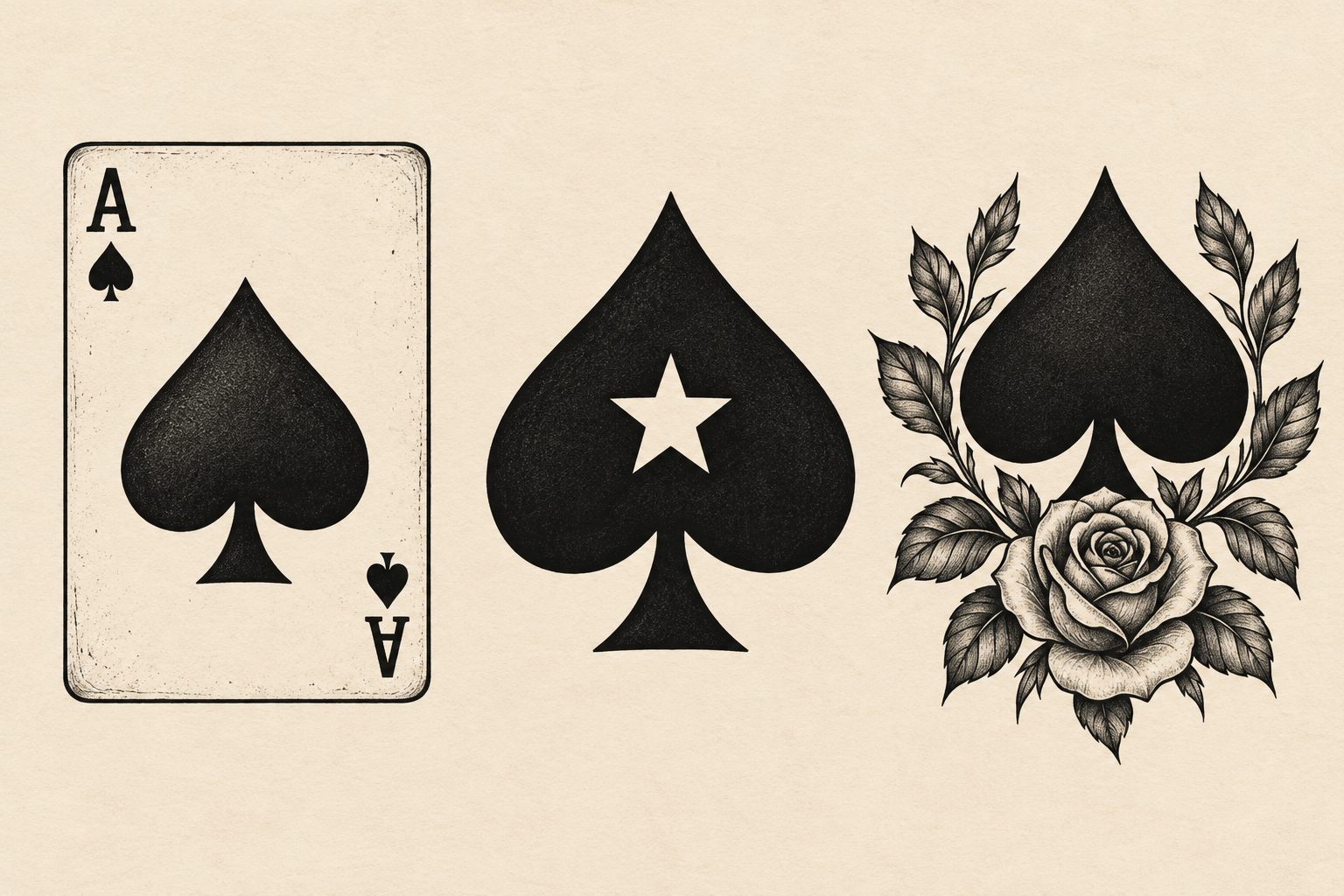
Look at what the proposed drawing actually includes. A plain spade shape, a full card marked A, and a skull inside a spade are three different starting points. Choosing among them is more useful than trying to find one meaning that cancels all the others.
The cover presents AI-generated card compositions for comparison. It is concept art, with no implication that the designs are finished tattoos or historical artifacts.
Start by separating the symbol from the story
A spade pip is the familiar pointed shape with a stem. It can refer to the card suit without naming a particular card. Add an A or draw the full indexed card, and the reference becomes more specifically an ace of spades. If you want the ace to be obvious, make that distinction part of the brief.
Luck and risk are available personal interpretations. A player might connect the card with a memorable game, while somebody else uses it to acknowledge uncertainty in life. Those are metaphors. The tattoo does not improve the odds of a future result, and the card is not highest under every set of rules.
For a specific game memory, write the game and the occasion in your notes. You might keep the image minimal while retaining that precise reason privately. If the idea is simply taking a chance, there is no need to invent a gambling history to make the design feel authentic.
The same care applies to mortality. A skull can make that theme more visible, but a plain ace does not necessarily carry it. Adding a skull changes the emphasis of the drawing; it does not disclose a dangerous personality or a military background.
What the Vietnam records show, and what they leave open
Playing-card manufacturer Bicycle says USPC sent ace-only decks following a February 1966 request from US officers in Vietnam. That is the company's own account of supplying the cards. It supports a specific historical connection, rather than a universal origin story for every death-card image. The account appears in Bicycle's company history.
The National Vietnam Veterans Museum also holds a surviving skull-and-spade card, documented with donor provenance in its Death card collection record, 2023.241. A preserved object establishes that such material existed. Soldiers' beliefs about how opponents would respond do not, by themselves, establish that the cards caused the intended fear.
For a tattoo, ask what relationship you have with this history. A family memorial may warrant a particular date, name or verified service detail. A purely decorative skull-and-card design can be described as that, without presenting it as an earned military insignia or implying a personal service record.
If you are referencing a relative's keepsake, bring its photograph and explain which details belong to the object. An artist can distinguish copying a particular memorial reference from making a new, fictional military-looking emblem. Avoid adding unit markings or a service story merely because a reference image contains them.
A music reference can be much more direct
Motörhead's official release material identifies Ace of Spades with its 1980 album and title track. The band's anniversary release page is a direct source for that connection. It does not require a second theory about the card's ancient symbolism.
If the music is your reason, decide how explicit you want the reference to be. A full card can keep it private; a separately written album title or a personally meaningful concert date makes it easier to explain. You can discuss a tribute without reproducing lyrics or copying a complete cover image.
One proposed brief might be a plain ace card with strong contours and a small date below it, leaving the card face open. Another might use an original spade shape within a larger music-themed piece. Their meanings come from your listening history and chosen reference, not from a rule about everyone wearing the card.
Before adding lettering, compare the design without it. If the symbol already brings the music to mind for you, a simpler image may be enough. If words are essential, give them a separate readable area rather than forcing them into the card's narrow border.
Ace-community use deserves its own context
The Asexuality Handbook's symbol explanation connects ace imagery with ace as shorthand for asexuality. First-person discussions on AVEN about ace and aro symbols also show variation: some participants associate the spade with aromantic asexuality, while others use or understand it more broadly.
Those sources establish community use and disagreement, not a rule for reading every tattoo. You cannot infer somebody's orientation from a spade. A person choosing an identity tattoo can describe the version that feels right to them without speaking for an entire community.
If this is your reason, consider whether you want recognition, privacy or both. A small standalone spade might keep the reference relatively understated; an additional element meaningful within your own identity can make the personal reading more explicit. Neither option obliges you to disclose anything when asked.
For a consultation, “a spade as my own ace symbol, with no skull or gambling imagery” is a clear brief. You can also state which associations you would prefer the drawing to avoid. The artist does not need to assign an identity to the symbol to respect your instructions.
Work through three example drawings
A full playing card for a personal luck reference
Start with a rectangle, an A and a small spade in the corner, plus the central pip. Decide whether the card should look flat, tilted or slightly bent. A tilted card may need more space than its upright dimensions suggest.
Check every index in the proposed drawing. A conventional card-style layout may put an inverted index at the opposite corner; make sure it is an intentional counterpart, not an accidental mirrored letter. If your artist simplifies the card, agree on which indices will remain.
Strong dark shapes can work within a blackwork approach, but the border should not merge with the corner markings. Keep the card readable before adding chips, dice or a banner. One card can carry a specific memory without illustrating every object associated with games.
A skull inside the spade for mortality
Decide which silhouette leads: the spade, or the skull. If the skull fills the entire shape, the stem and top point can disappear. If the spade dominates, the skull may need to be simplified so its main features remain separate.
A neo-traditional treatment offers a different visual direction from a plain card. For example, a clear spade outline, a simplified skull and one restrained accent can keep the focal point obvious. Adding a rose can express a personal contrast with beauty or remembrance; that combination does not have one compulsory meaning.
If you choose the flower, compare the bloom shape in the rose design collection and decide whether it belongs beside the spade or behind it. Both positions should preserve the recognizable outer shape.
A standalone pip for a quieter identity or aesthetic choice
Here the outline does most of the work. Compare a broad top with a narrow stem, and a longer form with a little more open space around it. Small changes can make it look heavy, delicate or closer to a leaf.
If you want the card reference to be clear, retain a recognizable stem and symmetrical shoulders. If you intentionally want a more organic shape, tell the artist which connection may be less obvious. Removing the A also removes the drawing's explicit ace label, so decide whether that matters to you.
Find a placement that preserves the card's geometry
A card face uses straight edges and regular spacing. On the forearm, check the stencil with the arm relaxed and turned, since the rectangle may appear different as it moves around the curve. Notice whether both corner markings are visible in the view you care about.
On the shoulder, a central spade can adapt differently from a full rectangular card. Compare the two rather than assuming a flat mockup transfers unchanged. A large enough open border may suit a card, while a standalone pip may fit the intended space more naturally.
For paired or stacked cards, confirm the visible indices before discussing decoration. A second card that hides the A may change what the drawing communicates. Ask for a stencil check in an ordinary standing posture, with attention to both the overall silhouette and the small letters.
Prepare your own explanation before booking
You can explore alternatives in the tattoo idea generator: one full card, one plain pip and one composition with a companion image. Treat the results as rough design studies. Check that the generator has not changed A to another letter, turned the spade into a club, or invented extra indices.
Bring the strongest option and answer these questions for the artist:
- Is my reference a card game, music, a memorial, identity or simply the shape?
- Do I need a visible A, or is the spade alone enough?
- Which details must remain readable from an ordinary viewing distance?
- Does an added skull, flower or date change the emphasis in a way I want?
- How does the card's rectangle look with my body relaxed?
You do not need an explanation that covers every possible ace of spades tattoo meaning. You need one that accurately describes your design. For a practical next step, print the card and the plain pip at two proposed sizes, mark the parts you would keep, and take those comparisons to the consultation. Use the aftercare guide when discussing the next stage with your tattoo professional.
References
- Bicycle: the manufacturer's historical account of playing cards
- National Vietnam Veterans Museum: the preserved skull-and-spade card, record 2023.241
- Motörhead: the official Ace of Spades anniversary release
- Asexuality Handbook: community explanations of ace symbols
- AVEN: participants discussing ace and aro symbol usage