
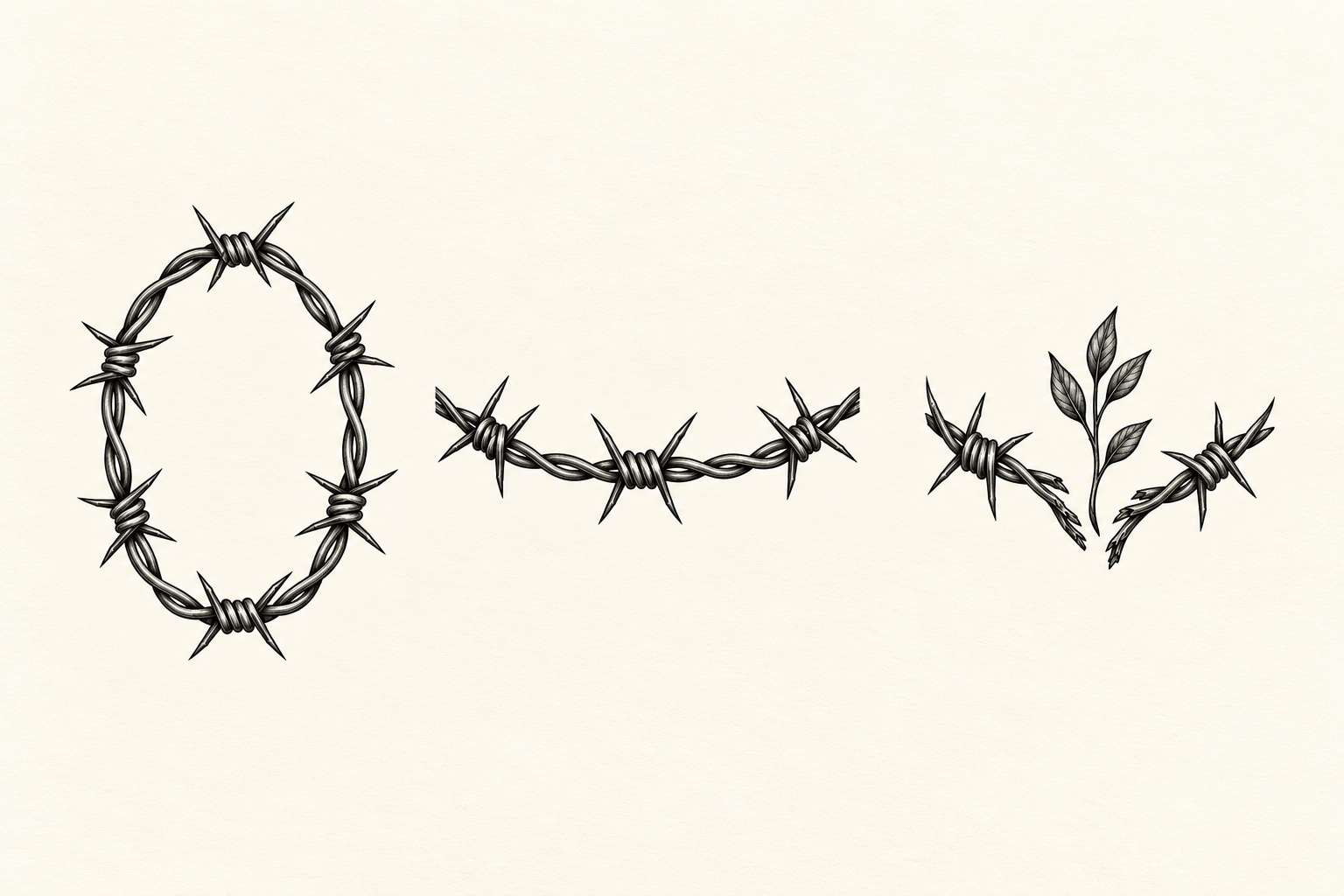
A closed ring of barbed wire and a snapped strand can tell very different stories. Barbed wire tattoo meaning often centers on boundaries, endurance, restriction or release, but the drawing cannot establish which story belongs to its wearer. Someone might choose it to mark a difficult period. Someone else might like its sharp rhythm around an arm. Both reasons can stand on their own.
Before choosing the number of barbs or adding a rose, decide what the wire is doing: keeping something out, holding something in, or coming apart. That small distinction gives the artist a much clearer direction than a list of abstract meanings.
The cover is an AI-generated comparison of wire compositions for an artist consultation. It does not show finished tattoos on skin.
What the wire can say
Boundaries are a useful personal reading because fencing visibly separates spaces. A strand across the outer forearm could remind you to protect your time or stop accepting a particular demand. That interpretation comes from your decision; it does not mean every wire tattoo represents the same experience.
Endurance gives the sharp points another role. You may connect them with something you have lived through, without putting the details on display. An intact, slightly irregular strand might suit that idea better than a dramatic break. There is no requirement to make the image look damaged to justify a survival story.
Confinement and freedom depend heavily on composition. A tight, uninterrupted band suggests enclosure. Two pulled-apart ends make release easier to read. Neither arrangement needs an accompanying slogan, although your own explanation can remain more private than the image suggests.
Decoration is also a complete answer. If you like the repeated twists and points, say so. An artist can then concentrate on balance, line weight and how the band sits on your body, without adding a trauma narrative you do not share.
A short history of the object, with a limit on what it proves
The US National Archives documents earlier fencing patents and Joseph Glidden's successful double-strand improvement, patented on November 24, 1874. Its account also describes barbed wire in property boundaries, wartime barriers and prisoner confinement. Those uses explain why restriction and defense can occur to a viewer. They do not date the first barbed wire tattoo or reveal a wearer's biography. See the archive's Glidden patent material for the historical object.
Keep that distinction when discussing a design. You can accurately say that your tattoo draws on the image of a barrier. Claiming it follows an ancient universal tattoo code requires different evidence. A familiar object can gather new personal meanings without one official origin story covering all of them.
Does it always mean prison time?
No reliable universal decoder establishes that conclusion. Claims such as one barb for each year served should not be used to judge a stranger. A local association might exist in a particular place or period, but it needs evidence specific to that context.
If you are worried about how people around you will read it, bring that concern to the consultation. A broken open strand, a flower-led composition or a clearly ornamental layout may communicate your intention more directly. None can control every viewer's assumptions. Choose a drawing you can explain honestly rather than a supposedly code-free symbol.
Five compositions, five different decisions
The closed armband
A complete band puts repetition and enclosure at the center. The meaningful choice is the relationship between the band and the arm: a narrow accent, a looser double strand, or part of a larger composition. A band does not acquire a fixed meaning simply by sitting on the upper arm.
Ask to see where the pattern meets itself. A misplaced join can look like an accidental break, which matters if continuity is the point. Compare it with the layouts in the arm placement collection, then ask your artist to adapt the wrap to your actual arm rather than copy a flat rectangle.
The broken strand
If release is your intended message, make the break visible. Two cut ends that almost touch may read as a drafting error from a distance. A deliberate gap, different directions at the ends and a little empty space around the opening give the action room to register.
For example, a diagonal strand on the outer forearm could separate near its upper third, with each loose end turning away from the gap. That is an editorial design suggestion, not a recognized code for a specific event. A subtler version can keep the break small but place it where you can see it easily.
The wire heart
A heart formed entirely from wire makes affection and sharpness share one outline. You might use that tension for guarded love, a relationship boundary or an experience you prefer not to explain. Avoid describing it as proof that somebody has been betrayed.
Check the heart's cleft and lower point before adding extra twists. If barbs crowd those two landmarks, the silhouette can become a knot. A heart with one open side also tells a different visual story from a sealed heart, so compare both on paper before choosing.
Wire and a rose
Here the practical question is which element leads. A small rose enclosed by a large ring puts emphasis on the barrier. A rose whose stem passes through an opening lets the flower carry more of the composition. You can connect either arrangement with affection, grief or protection, but those are optional personal readings.
Use the rose tattoo collection to compare bloom shapes before combining them with wire. One clear flower and a limited number of readable barbs may serve the idea better than several flowers, initials and a banner competing for the same space.
The loose ornamental strand
A short strand can work without a closed loop or a dramatic symbol. Think of it as an arrangement of twists, points and empty spaces. A gentle curve can follow a limb; an angular turn can frame an existing piece.
This is useful if the visual rhythm matters more to you than a story of escape. Tell the artist which part you like: the double helix, the alternating points, or the open shape. That gives them something specific to preserve while simplifying the rest.
Choose a drawing style that supports the message
In a blackwork treatment, a strong dark strand can make the barrier feel visually forceful. The artist still needs to separate overlapping wires and leave readable gaps around the barbs. Solid black everywhere can turn a twist into an indistinct junction.
A fine-line approach can emphasize the construction of the wire. Ask which details need more room at your chosen scale. A digital mockup can display tiny twists that a tattoo artist may prefer to simplify; the mockup is a conversation aid, not a guarantee of the result.
For a larger piece, compare two versions with the same outline: one built from simple repeated marks, the other with more material texture. If the meaning depends on an obvious break, both should preserve that gap. Style can change the mood while the main action remains legible.
Test the wrap on a moving body
A band is a three-dimensional drawing. Its front, back and join may never appear together in one view. For a forearm placement, check the stencil with the hand relaxed at your side, palm turned upward and elbow bent. Notice whether the intended focal point rotates out of sight.
For a complete upper-arm wrap, ask where the artist would put the join and how the line follows the arm's changing width. If you want the break to face you, say that before the stencil is positioned. If you want other people to see it while your arm is resting, that may require a different location.
Photograph the stencil from several ordinary viewing angles if the artist agrees. Look at the silhouette first, then the details. The important check is whether you can still distinguish intact wire, a purposeful opening and the chosen companion image. Do not rely only on a close-up taken with the skin held flat.
Turn your meaning into a useful artist brief
Write one sentence about the role of the wire. For example: “An open strand that marks a boundary I can choose to change.” Then describe the drawing rather than adding more symbolism: diagonal forearm layout, one visible gap, two loose ends, no lettering.
Bring a contrasting version as well. You could use the tattoo idea generator to compare an intact band with that open strand, clearly treating both outputs as concept art. Check the number and direction of the ends yourself; an image generator may merge wires or invent joins. Your artist should redraw the final arrangement for the placement.
These are useful consultation questions:
- Can the break stay obvious when my arm hangs naturally?
- Where would a full band's join sit, and will it look intentional?
- Which twists or barbs should be simplified at this size?
- Does the rose or heart still read clearly without a close-up?
- Can we compare a plainer version before adding dates or lettering?
If the design is a memorial, the memorial tattoo collection offers other ways to give a name or date its own space. Wire does not have to carry every part of the story. Once the drawing is agreed, use the tattoo aftercare guide alongside the instructions from your tattoo professional.
Questions that often change the final sketch
Is barbed wire the same as a crown of thorns?
They are different objects. Manufactured wire has twisted metal strands and attached barbs; a thorny branch has plant structure. You can ask for an intentional religious reference, but make clear which object you want drawn. A circular shape alone does not resolve that choice.
Does a broken wire always represent freedom?
It can suggest release, and that may be why you choose it. Another wearer might connect the break with loss or an unfinished connection. If freedom is your intended barbed wire tattoo meaning, a clearly separated pair of ends supports the story more directly than a hidden interruption.
Do I need a difficult personal history to wear it?
No. Liking an ornamental shape is enough. The useful next step is to bring two drawings to your artist: the version that best expresses your reason, and a simpler version with the same main outline. Decide which parts still matter when the extra details disappear.