
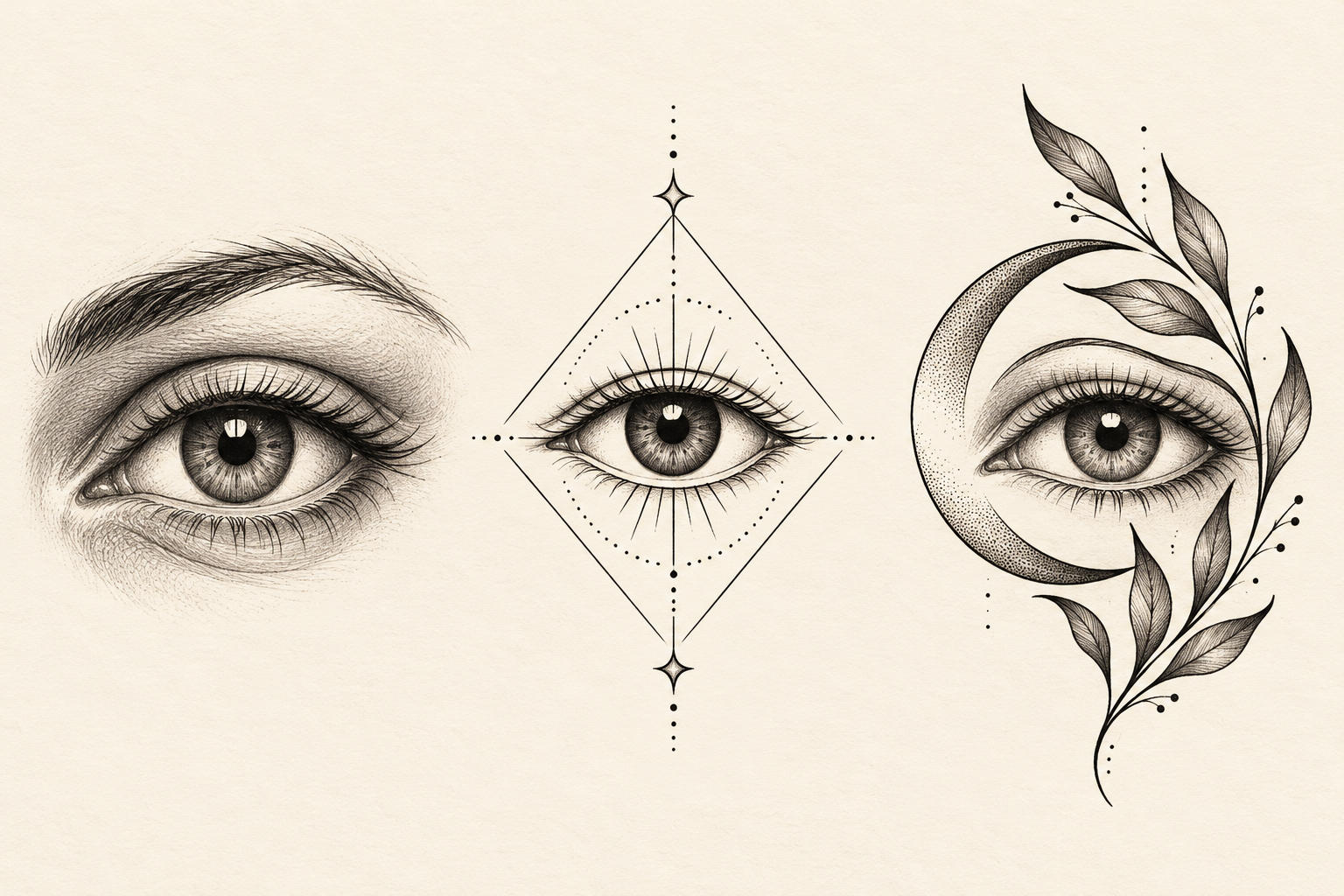
A human eye, the Eye of Horus and an eye above a pyramid can look related at thumbnail size. Their contexts are different. Eye tattoo meaning might involve attention, a remembered person, protection as a belief, or a named religious image. The first useful question is which eye you have chosen. Once you identify it, the frame, gaze and surrounding details become easier to discuss. You can also explain a personal interpretation without presenting it as a rule for everyone else's tattoo.
The AI-generated cover shows a detailed human eye, an eye within a diamond, and an eye with a crescent and leaves. These are original concept illustrations. None is presented as a verified Horus, Providence or historical protective emblem, and none is a photograph of a tattoo.
What an ordinary human eye can mean
An eye can stand for paying attention when you choose it for that purpose. A reader who wants to become less distracted might prefer an alert, open eye with little surrounding ornament. Someone remembering a relative may care more about a particular eyelid shape or eyebrow. Those are two different briefs, even though both begin with an eye.
A generic illustration cannot reproduce a person's likeness just because it looks realistic. If recognition matters, bring a suitable reference you have permission to use and describe the details you want preserved. The direction of the gaze, fold above the lid and position of a highlight may matter more than adding another ring of eyelashes.
An inward-looking interpretation can also work. You might choose an eye to represent examining your own choices, with an open frame suggesting room to reconsider. That is a design proposal, not a documented ancient definition of a diamond around an eye. Compare the actual frames in the eye tattoo ideas collection before giving one a cultural name.
The Eye of Horus has a specific reference
The Metropolitan Museum of Art describes the wedjat as a combined human and falcon eye associated with the restoration of Horus's injured eye. Its discussion connects the amulet with regeneration and protective beliefs. See the museum's Wedjat Eye Amulet record. These are historical religious associations, not evidence that a tattoo heals or protects its wearer.
For an Eye of Horus tattoo, keep a named reference beside the sketch. Its distinctive markings are part of its identity. A realistic eye with an arbitrary curl below it should not be confidently labelled an accurate reconstruction. Ask the artist which details come from the reference and which have been adapted for the composition.
Suppose the attraction is restoration after an interrupted project. You can state that personal connection, while acknowledging where the image comes from. If you simply prefer the shape, say that too. You do not need to invent an Egyptian ancestry for your own experience to make the choice meaningful.
The tattoo style hub helps compare treatments such as sparse linework and heavier shading. Style changes the rendering. It does not supply missing historical evidence about the symbol.
Providence and the protective eye need separate explanations
The US State Department's Great Seal history documents the Eye of Providence in a triangle above the unfinished pyramid on the reverse of the seal. That is a specific emblematic setting. A triangle around an eye can evoke that context, but a stranger's tattoo does not establish their organisation, religion or political allegiance.
If Providence is your intended reference, decide whether you want the triangle alone or the wider composition. A pyramid, rays and lettering introduce more details to identify and explain. If you want personal awareness without those associations, an unframed human eye may better match your brief.
Protective-eye interpretations also require care. In one Met amulet record, the museum offers an abstract-eye reading as a possibility and explicitly retains uncertainty about the motif's meaning. That uncertainty matters. Similar-looking circles do not prove one unbroken tradition behind every modern eye tattoo.
You can choose protection as a personal wish. Describe it as a wish or belief, and identify a specific cultural reference if you are using one. Avoid combining several unfamiliar emblems merely because a search result labels all of them protective.
Framing, tears and gaze change the design brief
Open eye or closed eye
An open eye gives the artist a visible iris and a direction of attention. A closed eye shifts the focus toward the lid, lashes and contour. You might use the first for curiosity and the second for quiet reflection. Neither expression has one compulsory meaning.
Try two sketches with the same frame and different lids. That comparison reveals how much of the mood comes from the eye itself. For an understated version, the fine line collection offers examples of spacing to discuss rather than a promise about how tiny a finished tattoo can be.
Tear or no tear
A tear can suggest grief, release or a particular memory when the wearer chooses that interpretation. It also adds an element viewers may read differently. Shape and placement alone cannot reliably establish someone's history or affiliations. If you want a memorial image, explain who or what you are remembering instead of relying on an alleged code.
Consider whether one clear tear supports the story or simply competes with the pupil. A separate date or initial may feel more precise. The memorial tattoo collection provides other ways to organise a remembrance without making the eye carry every detail.
Geometry, crescent or leaves
A diamond creates an axis; a crescent introduces an asymmetrical curve; leaves make a softer outer silhouette. Those are visual effects you can observe in a sketch. They do not establish sacred status or a fixed spiritual meaning.
For example, a botanist might connect a leaf-framed eye with close observation. The leaves could be chosen from a plant that matters to them. A specific personal connection is more useful to an artist than a long list of intuition, destiny, wisdom and universal energy.
Turn the idea into a workable eye tattoo brief
Start with the intended subject: ordinary human eye, a portrait detail, wedjat or another identified emblem. Add one sentence about the meaning you want. Then describe the visible choices that support it.
An example brief could read: one human eye looking slightly outward, a simple upper lid, one clear highlight and two loose leaf stems. The idea is attentive observation. Keep religious frames out of this version, and compare a detailed drawing with a simplified one at the proposed size.
Bring the intended location to the discussion. A horizontal eye may need a different arrangement on the forearm than a narrow vertical crescent-and-eye composition. Ask for a paper-size comparison and let the artist identify which small marks need more space. A flat digital reference cannot settle that decision.
Before the appointment, put a name next to every borrowed symbol in your reference folder. Remove the ones you cannot explain. Keep the version whose eye, frame and personal story agree with one another.