A broad, fierce mask can appeal for its expression before you know its name. Oni mask tattoo meaning needs that next step: identify the reference before assigning a story. A modern horned-mask design, a festival image and a named Noh mask are not interchangeable sources. You might choose the image for confronting fear, controlling anger or enjoying a powerful silhouette. Those can be personal interpretations. They should not become claims that every oni protects its wearer or that every horned mask is Hannya.
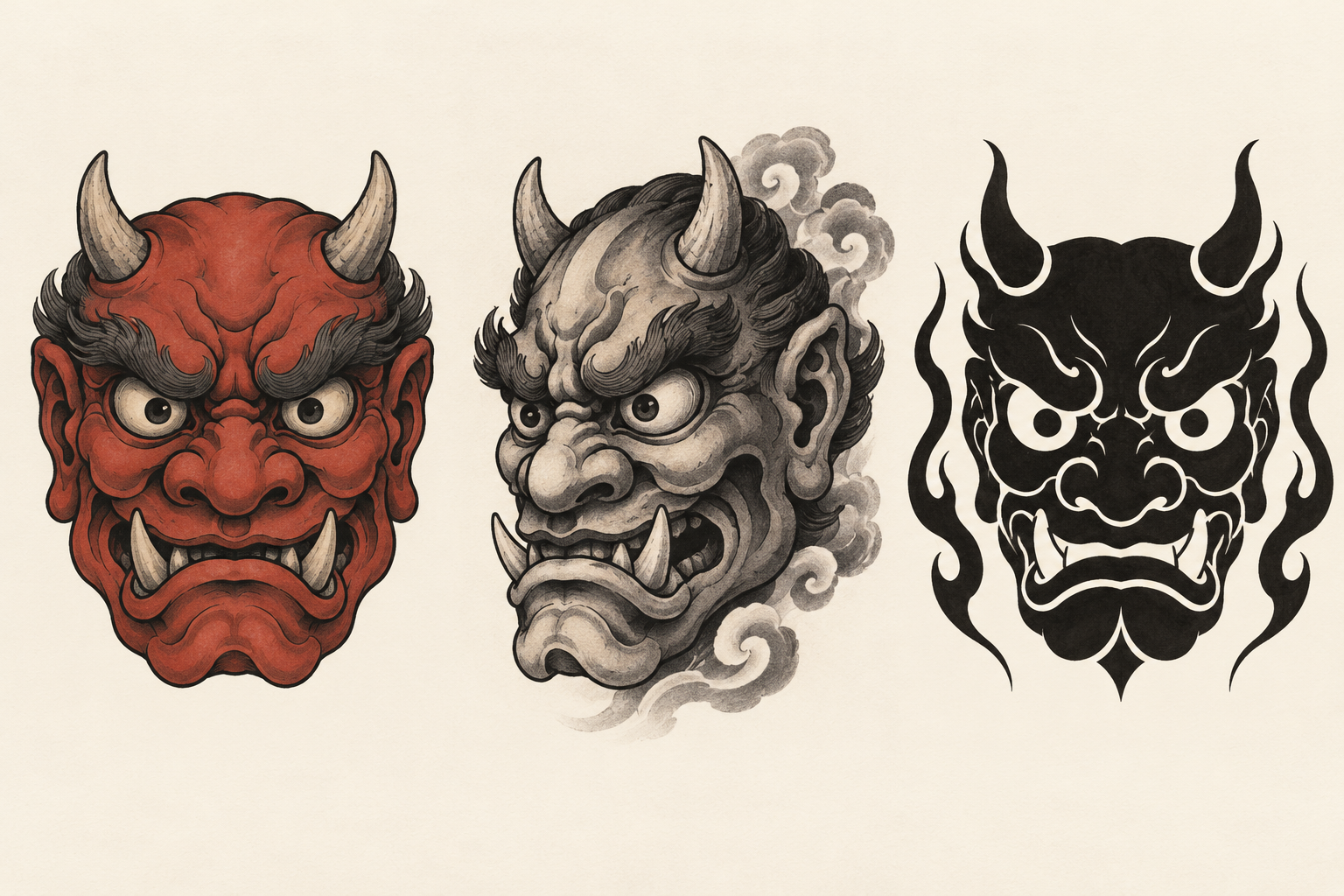
The AI-generated cover shows three original modern oni-inspired masks: a red frontal face, an angled black-and-grey face with a cloud curl, and a dark silhouette with open flame-like curves. These are concept illustrations, not museum replicas, verified stage masks or photographs of finished tattoos.
Give the expression a job in your own story
A fierce face can represent facing something you fear when you choose that reading. It might also remind you to recognise anger before acting on it. Those two ideas suggest different expressions: one more outward and confrontational, another tense but contained.
For example, someone who wants a reminder of restraint could ask for a heavy brow and closed, firm mouth. Another person who loves dramatic illustration may prefer exposed fangs and a wide jaw simply for the visual effect. Neither preference requires inventing an ancient personal lineage.
Write the intended action in ordinary words. I want to notice anger before it controls my decisions is a more usable brief than strength, courage, protection and invincibility together. The artist can translate the action into brows, mouth, tilt and negative space.
Compare the three studies in the oni mask tattoo collection. The broader face, angled view and simplified dark shape offer separate decisions. Choose the structure before adding flowers, weapons or lettering.
Setsubun does not make every oni a protective figure
JNTO's English Setsubun article describes throwing roasted soybeans while calling for demons to leave and good luck to enter. In that named custom, the unwanted figures are driven away. It does not support a blanket statement that all oni are benevolent guardians or that an oni tattoo provides protection.
If Setsubun is your actual reference, explain what you want to remember about it: the performance of driving something away, a festival visit or a family custom you know. A tattoo inspired by that memory can carry your own meaning without making a supernatural promise.
The distinction matters for design. A frightening face used to represent what you confront is a different idea from an image you personally regard as watching over you. Both require the wearer to explain the role. A search-result label such as protection cannot settle it for you.
Avoid assigning a fixed annual date from an older festival article when preparing a personal date inscription. Verify the actual event and year you mean. The general custom is the useful context here; this article is not a current festival calendar.
Oni and Hannya need different reference folders
The Noh specialist site the-noh.com explains mask categories, including demonic figures and ghosts or spirits. It lists Hannya among female spirit-mask examples. That does not turn all oni imagery into a simple male category with Hannya as its universal female equivalent.
The same site describes how small changes in a mask's tilt can change its expression on stage. This is a useful reason to compare angles, not a rule that every horned face expresses the same emotion. A tattoo drawing also lacks the changing movement of a live performance.
For one specific narrative, the site's Kanawa synopsis follows an abandoned woman whose anger leads to a demonic transformation. She is driven off temporarily. That is the story of a named play, not the definition of every Hannya image or every oni mask tattoo.
If you intend Hannya, label that choice and bring an identified reference. If you want a broad modern oni-inspired face like the cover, use that description. The names help the artist understand what to preserve and what kind of claim to avoid making about an original sketch.
A museum reference may not be a wearable mask
The Met's eighteenth-century Noh Mask of a Demoness, Hannya is catalogued as a matted painting with coloured papier-mâché relief against paper. Calling this particular object a carved wooden performance mask would misidentify the medium.
That example shows why an image's title is only part of a reference check. Read the object description before asking for a historical replica. A work depicting a mask, a mask used in performance and a modern tattoo concept have different purposes.
For your own design, a museum record can help you name the reference without requiring a copy. You might request an original composition influenced by an identified expression, while keeping the stage-mask identity out of the description of your modern concept.
The Japanese tattoo style collection offers a visual comparison of composition and background. It cannot certify a new drawing as an authentic theatrical object.
Horns, colour and view change what the viewer sees
Front view or angled face
A frontal mask makes symmetry and the space between the eyes prominent. An angled face changes the jaw outline and can expose one horn more clearly than the other. Ask the artist to keep the view coherent so a turned face does not accidentally acquire extra features.
Try the mask alone before adding a large background. For a forearm placement, compare the centreline with the relaxed arm. A face that looks balanced on a flat screen may need a different arrangement on a curved surface.
Red, grey or dark silhouette
The cover's red, grey and black versions offer different colour and contrast decisions. They do not establish universal personality labels or a fixed moral ranking of mask colours. If a particular colour has meaning in your chosen reference, verify that context rather than borrowing a generic chart.
For a silhouette, preserve readable eye, nose and mouth gaps. The blackwork collection shows why unfilled space matters when large areas are dark. For a more restrained drawing, compare the fine line collection and ask which facial marks can be removed.
Companions and background
Cloud curls can give an angled face a surrounding rhythm. A flower may add a personal reference or a softer shape; the rose collection offers forms to compare. Neither addition automatically supplies a historical meaning for the mask.
If lettering is necessary, write it accurately and identify the language before it enters the sketch. Decorative marks should not be described as verified sacred writing. A strong face may already carry enough detail without a caption beneath it.
Bring a named reference and a clear personal interpretation
A practical brief could read: modern oni-inspired face, a reminder to recognise anger and act with restraint, broad brow, two coherent horns, firm mouth, no historical-mask replica claim. Request one frontal version and one angled version before choosing a background.
Keep the cultural source, your personal interpretation and the artist's new composition clear in your notes. That gives the design room to be original while keeping its description accurate.