
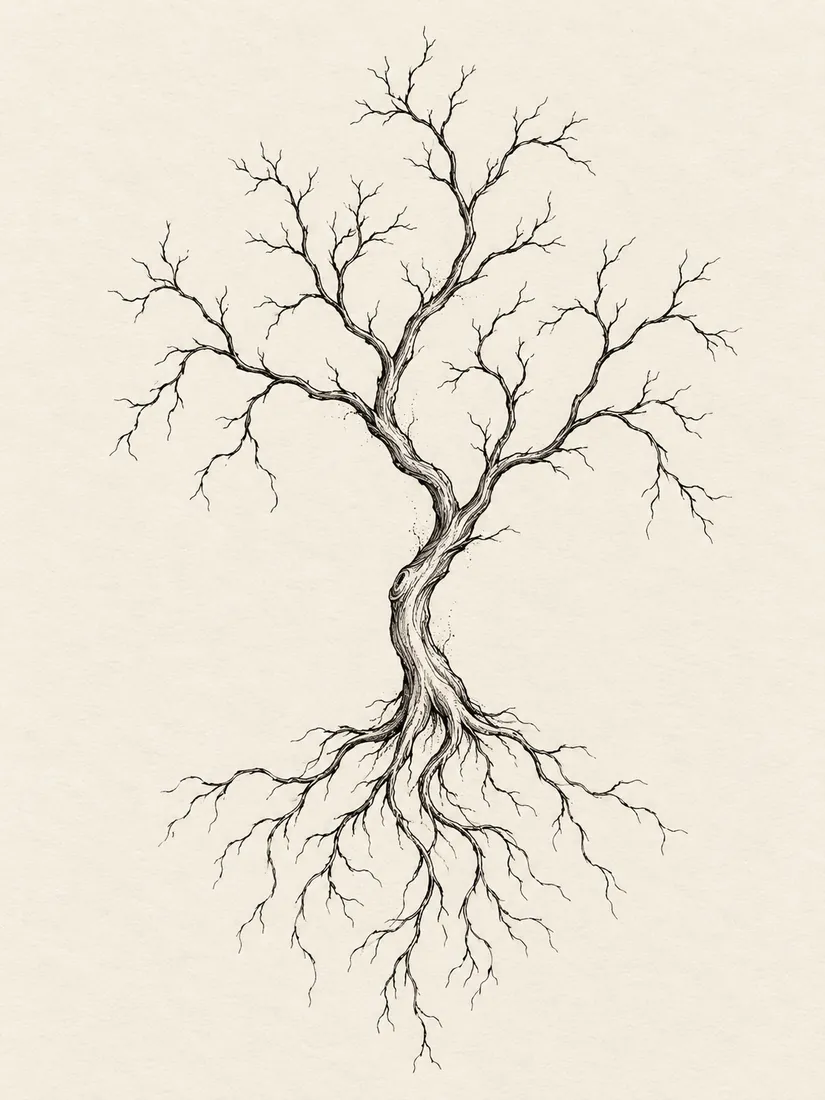
A bare tree and a single apple can tell a very different story from a tree covered in new leaves. The poison tree tattoo meaning often draws on William Blake's poem A Poison Tree: anger that is hidden, fed and allowed to grow. Some wearers use that story as a warning about resentment. Others adapt it into a personal reminder to speak honestly or leave an old conflict behind. The literary reference gives you a starting point; the meaning you choose determines what belongs in the design.
Before choosing branches, roots or a quote, decide which part of that story you actually want to carry. This guide separates the poem from later interpretations and turns those choices into a practical design brief.
What the poison tree means in Blake's poem
Blake opens with two responses to anger. The speaker tells a friend about his anger and it ends. He conceals anger toward an enemy, then nourishes it through fear, tears and deceptive friendliness. The imagined tree eventually bears an attractive apple. The enemy enters the garden at night, and the speaker finds him beneath the tree the following morning.
That contrast supports a reading about resentment becoming destructive when it is cultivated. The tree is the poem's image for the growing feeling. The ending also makes the speaker's pleasure unsettling; it is a poor fit for an uncomplicated message about healthy growth. You can read the short public-domain poem at the Academy of American Poets.
The wording matters. The poem describes a bright apple and an enemy lying beneath the tree. It does not narrate a detailed poisoning scene or explicitly describe the act of eating. A tattoo with dripping poison, a skull or a snake adds imagery chosen by the designer. Those additions can work, but they are not a direct illustration of every detail in the text.
Literary meaning and personal meaning can differ
A tattoo inspired by a difficult poem does not reveal a stranger's history or intentions. You cannot infer a diagnosis, a traumatic experience or a desire for revenge from a tree on somebody's arm.
For your own design, it helps to write a private sentence explaining the intended meaning. Here are three different briefs:
- A reminder to discuss conflict before resentment grows.
- A marker of a relationship or period that you have chosen to leave behind.
- An appreciation of Blake's imagery, with no autobiographical claim.
These choices lead to different artwork. The first might keep one apple as a clear focal point. The second might add a broken branch or a new shoot as an invented personal element. A literary piece might echo the garden setting more directly. None of those additions has a universal meaning that every viewer will read correctly.
If you want visual starting points, the poison tree tattoo generator shows several design directions. Treat the examples as concepts to discuss and adapt.
What the main design elements can communicate
The following suggestions are design interpretations for your brief, rather than a fixed dictionary of symbols.
| Element | A possible role in your design | A useful question |
|---|---|---|
| Bare branches | An exposed, tense or winter-like mood | Do you want the silhouette to feel quiet or threatening? |
| One apple | A clear link to the poem's fruit | Should the fruit be the first thing someone notices? |
| Visible roots | A sense of origins or a feeling taking hold | Do the roots add something the branches cannot say? |
| New leaves | Your own idea of renewal | Are you deliberately changing the poem's ending? |
| A short quotation | A more explicit literary reference | Will the words remain clear at the intended size? |
| A garden frame | A setting for the narrative | Is there enough space for the tree and its surroundings? |
Try removing one element at a time. If the design still expresses your intended story, the simpler version may make a stronger starting point. A large tangle of roots, several apples, a snake and a quotation can compete for attention.
Choose a style that supports the story
Fine line: An open branch structure can give the tree a restrained, delicate character. Keep visible space between branch tips and avoid squeezing every root into a small design. Our fine-line tattoo examples can help you compare how much detail you actually want.
Blackwork: Darker masses create a stronger silhouette. Decide which spaces should stay open so the tree does not become one solid shape when viewed from a distance. Compare blackwork designs against the lighter version before deciding.
Etching or sketch direction: Uneven branch lines and controlled hatching can suggest a printed illustration. Ask for a purposeful line hierarchy rather than adding texture everywhere. A tattoo artist will need to decide which marks are appropriate for the final design.
A restrained color accent: A single colored apple can draw attention without filling the whole canopy. You can choose the color for a personal association or for contrast. A red apple does not automatically turn the tattoo into a particular religious or psychological statement.
Plan the placement around the silhouette
Draw a loose rectangle around the complete tree. A tall, narrow silhouette can be easier to compare along a forearm; a broad canopy needs more horizontal room. A wrist-sized concept usually benefits from fewer branches and less text. The artist should assess the final scale on your body.
Decide how the tree should face when your arm rests naturally. Then compare that orientation with your arm turned. A flat image cannot show every change created by skin, movement and perspective.
Use the photo try-on tool to compare position and relative size. Its preview is a visual aid, not a promise of how the finished tattoo will look after healing. Ask your artist to place a physical stencil before the appointment proceeds.
Write a brief your artist can use
A useful brief gives the artist a story, a visual hierarchy and a few boundaries. For example:
A tall blackwork tree for the inner forearm. The main idea is acknowledging anger before it grows. Keep one clearly separated apple, an open canopy and a simple root system. No skull, snake, portrait or added quotation. Please adapt the line spacing and scale for the placement.
This brief leaves room for the artist's judgment while making your priorities explicit. You can ask the tattoo idea tool for alternative concepts, then compare two or three options with the same placement and mood. Changing everything between versions makes the comparison less useful.
If you create an AI draft, inspect the branch intersections, the number of apples and any text yourself. Use stencil conversion to inspect an outline draft, then let the artist decide what must be redrawn. A clean-looking digital outline does not establish that the design is ready to tattoo.
Questions that often come up
Does a poison tree tattoo always mean revenge?
Revenge is one possible reading of the poem's ending. A wearer might instead focus on communicating honestly, rejecting bitterness or appreciating a piece of literature. Ask the person if they wish to explain it; the image alone cannot supply their answer.
Is a snake required?
No. A snake is an additional design choice. If you want a direct reference to Blake's poem, the tree, apple and garden already provide recognizable material without it.
Can it represent recovery or a new beginning?
You can choose that personal meaning. New shoots, an opening canopy or a separated fallen apple could support your interpretation. Describe the intended change to the artist instead of assuming the image has a universally recognized recovery meaning.
What should I take to a consultation?
Bring your short meaning statement, a few references, an approximate placement and the details you want excluded. Explain which image came from an AI tool. The artist can then adapt the artwork and discuss whether the composition suits the available space.
Read the poem once, write your meaning in your own words, and choose two design directions to compare. You will have a clearer brief than a folder of unrelated tree pictures. For practical care after the appointment, keep the separate tattoo aftercare guide available alongside the instructions for your own tattoo.
Sources and editorial notes
Research checked on October 16, 2026. Literary interpretation is based on the poem; composition examples and prompts are original editorial suggestions. This guide does not assign a medical history or personal identity to tattoo wearers.