A scorpion with raised pincers can look defensive. The same animal in a quieter pose can feel observant and contained. Scorpion tattoo meaning may involve boundaries, resilience, a Scorpio identity or a personal attraction to the animal. Historical protective amulets add another context, with their own limits. None of these readings automatically applies to every wearer. Decide what you want the animal to express, then check that the pose and anatomy support it.
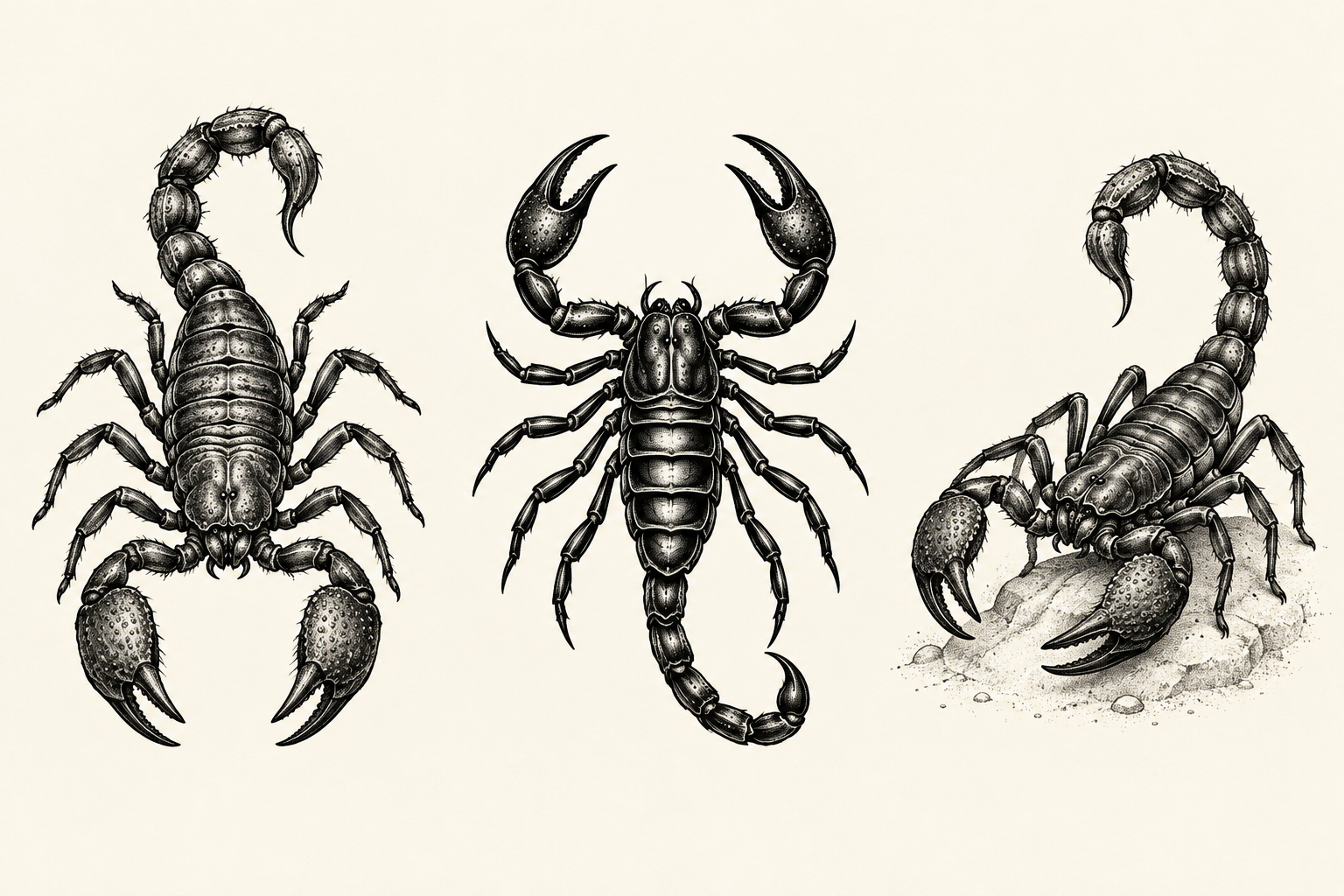
The AI-generated cover shows a top-down scorpion, a bolder upright arrangement, and an angled scorpion on a small rock. These are original concept illustrations. They are not museum replicas or photographs of completed tattoos; an artist should check the limbs and joints during the redraw.
Boundaries are more useful than a vague claim of danger
You can choose a scorpion as a reminder to defend a boundary. Naming the boundary makes the idea less abstract. Someone learning to protect study time might want a compact, self-contained animal. A person marking the end of an exhausting commitment may prefer a pose that feels ready but still.
That personal meaning does not require claiming a history of violence. You can explain the scorpion as a reminder to respond deliberately. Open pincers, a curved tail and an undisturbed space around the body can support the composition without making every surface aggressive.
Compare a fully spread animal with a narrower, angled version. The first exposes the overall structure; the second may create more movement. Your preference can reveal whether the design is mainly about a clear emblem or a particular creature.
Use the tattoo ideas hub to compare that decision with other animal references. Choose the animal because its shape and your explanation fit together, rather than because an unsourced list assigns it the strongest personality.
Scorpio is a chosen identity reference
A scorpion can stand for Scorpio when that is your intention. The animal alone does not prove the wearer has that astrological sign, and it cannot establish a personality. Traits assigned through astrology belong to a belief framework, rather than a diagnosis of the person wearing the image.
If the sign matters to you, decide whether the animal already makes the reference clear enough. A glyph, date or star arrangement adds a separate element that needs checking. An arbitrary group of dots should not be labelled the actual constellation without an astronomical reference.
For example, a Scorpio-inspired design could use one scorpion with a small personal date outside the legs. The date records something you choose; it need not be presented as proof of a predicted future. Keep the number style separate from the animal until both remain readable at the intended scale.
The tattoo font generator can help compare a short date or initial. Confirm the characters yourself and let the artist decide how much space the text needs beside the body.
Historical amulets document beliefs about protection
The Science Museum Group records a scorpion-shaped amulet from Kashan, dated 1800–1920, intended as protection against scorpion stings. This documents a protective belief. It does not demonstrate medical effectiveness or show that a modern tattoo can prevent injury.
The Met also catalogues an Egyptian New Kingdom two-sided amulet inscribed with scorpions and lizards, dated about 1550–1300 BCE. The record provides no image. Its title and date cannot support invented details about the object's appearance or establish an uninterrupted lineage to contemporary tattoo designs.
These objects can help explain why protection enters a discussion of scorpion symbolism. Keep their different dates and settings intact. Combining them into a universal ancient meaning would erase what the sources actually identify.
If protection appeals to you, describe it as a personal wish or association. An original animal drawing can carry that wish without being called an authentic Egyptian or Persian talisman. Your design brief should distinguish the creature you want drawn from any historical object you are citing.
Check the creature before deciding how much detail to keep
A recognisable scorpion has eight walking legs, two front pincer-bearing appendages and a segmented tail ending in a stinger. In an angled view, some structures may be partly hidden. Ask for a traceable drawing rather than counting whatever dark marks happen to be visible in a generated image.
Start with the body and follow each appendage outward. A pincer should connect coherently; the tail should have one route to its tip. Texture and shading can make an incorrect joint look convincing at first glance. They cannot fix the underlying shape.
For a small design, simplify surface marks before compressing the gaps between legs. The fine line collection offers examples of open spacing, while the blackwork collection shows how unfilled gaps contribute to a dark silhouette. Neither replaces the artist's anatomy check.
For example, a detailed top-down scorpion may need fewer shell textures and wider spaces between the legs in its smaller version. Ask for that simplified redraw beside the full illustration. Judge the animal's silhouette before choosing the richer surface.
Tail direction and companions should serve your story
A tail curling over the back creates a compact shape. A tail extending sideways makes a wider composition. Neither direction has a compulsory emotional code. Choose according to the outline and how it fits the proposed area.
A flower can create a contrast between hard and soft forms, if you want that relationship. Give the flower a reason to be there: a favourite plant, a person's name connection or an aesthetic preference. You can compare rose tattoo ideas without claiming that a scorpion and rose always mean love after betrayal.
Likewise, a date may record a private event; a rock can simply give the animal a surface. Adding flames or a weapon changes the emphasis and may be unnecessary when your theme is restraint. Prepare the animal alone first, then test one companion at a time.
Bring a specific scorpion brief to the artist
Write three things: your intended meaning, the pose and the detail you want preserved. An example is: a reminder to hold a boundary, a compact top-down animal, clear pincers and one curled tail, with enough open space to distinguish the legs. Add the intended dimensions and ask for an anatomy review.
For the forearm, compare an upright body following the arm with a diagonally placed animal. Look at both with the arm relaxed. A flat concept sheet does not settle which will read more clearly on your body.
Avoid decoding other people's scorpions through prison, gang or personality claims from a generic symbol list. You have a more useful task: choose the image whose anatomy, pose and personal explanation you can confidently bring to an artist.