
An ornamental crown can celebrate an achievement. A crown of thorns points toward a different story. Crown tattoo meaning depends on the object you draw and the reason you choose it: self-worth, responsibility, a relationship, faith or an entirely private memory. The shape alone cannot tell a viewer which meaning applies. Start by naming the kind of crown. Then decide what, if anything, belongs beneath it.
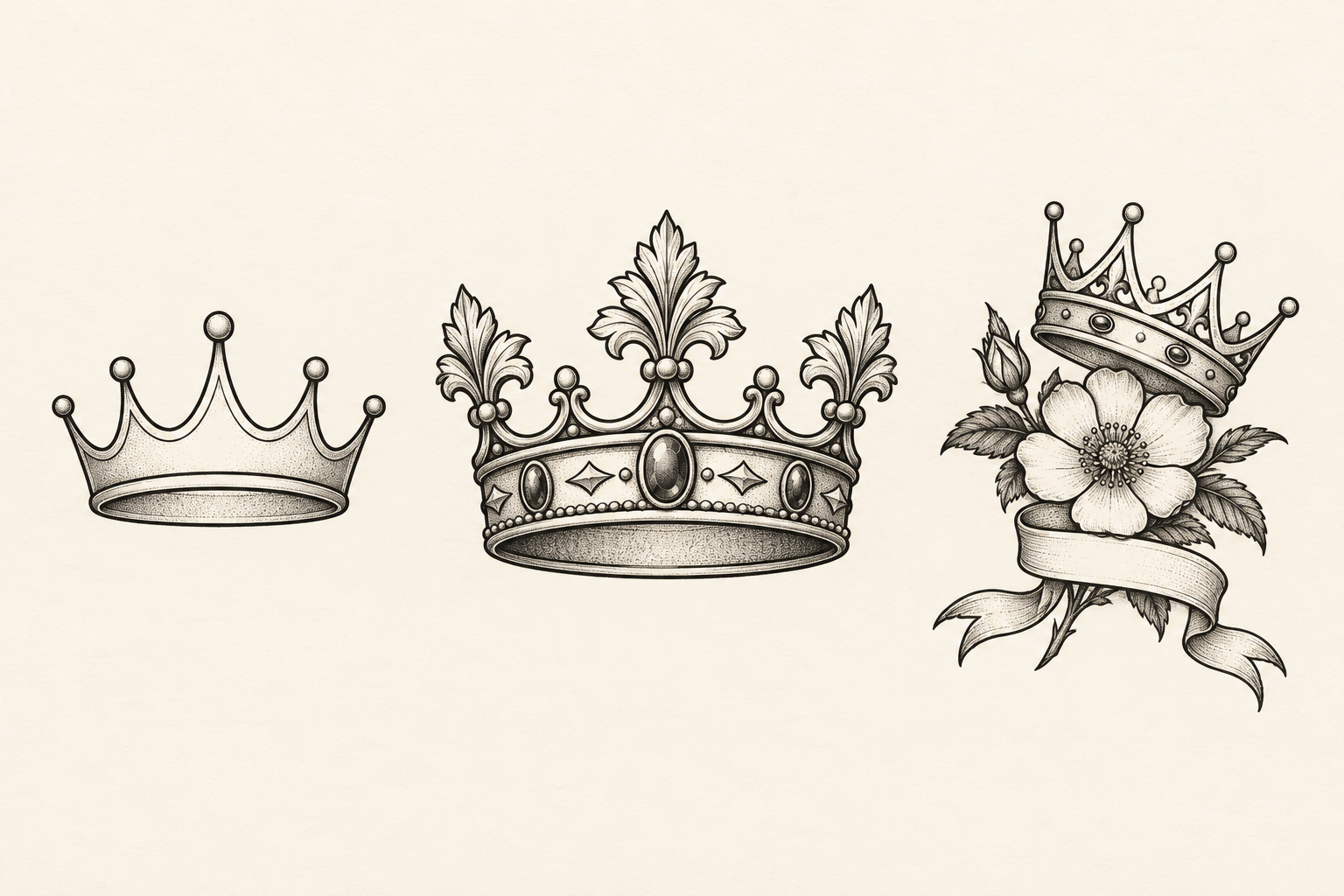
The AI-generated cover compares a simple open crown, an ornamental circlet with leaf-like finials, and a tilted crown above a rose and blank ribbon. These are original concept drawings, with no claim to reproduce a royal insignia or show finished work on skin.
Self-worth becomes clearer when you name the commitment
You can choose a crown as a reminder to value yourself. That reading becomes useful for a design when you connect it to an action. Someone who wants to stop apologising for taking time to study might use a modest outline crown as a private reminder of that commitment. Someone celebrating a qualification may prefer a date beside it.
The crown does not need to imply superiority over other people. You can describe its meaning as responsibility for your own choices. If that is your aim, a balanced upright shape may feel closer to it than an exaggerated crown surrounded by money and weapons. Those are compositional choices, not a hierarchy of acceptable meanings.
An achievement design benefits from one specific milestone. Think of finishing training, becoming a parent or completing a long creative project. A small initial or date can carry the detail while the crown gives the design its recognisable silhouette. Compare initial tattoo ideas if lettering needs to remain a distinct part of the composition.
A historical crown can represent responsibility as well as status
The Royal Household describes coronation regalia in terms of a monarch's service and responsibilities. Its Coronation Regalia page identifies St Edward's Crown as made in 1661. This is a named ceremonial context, not a universal definition of all crown tattoos. The page was prepared for the 2023 coronation; its event language should be read in that setting.
For your design, distinguish a historic object from a general crown shape. A museum or official reference may contain crosses, arches or other features with their own context. An original ornamental crown can instead use simplified points and a plain band. Both options deserve an accurate label.
Suppose your theme is the weight of caring for others. You might choose a restrained, slightly heavier band and leave out extra jewels. That is your contemporary interpretation of responsibility. It does not make the tattoo an official emblem or suggest a royal appointment.
Browse the tattoo style hub to compare how line, shading and mass change the same object. A black silhouette reads differently from a detailed circlet even when the personal story stays the same.
The crown of thorns belongs to a specific faith narrative
In John 19:2–3, King James Version, soldiers put a crown of thorns on Jesus and mock him. A Christian wearer may connect that passage with suffering, devotion or faith. Those are different starting points from a jewelled crown celebrating personal success.
If the crown of thorns is your intended image, make that explicit in the brief. Branches, thorns and an open centre need a different drawing approach from metal points and gems. A cross or verse reference can make the religious context clearer if you want it visible.
A verse reference also needs checking. Read the full passage in the translation you intend to use, then confirm the book name, chapter and verse before the artist redraws any text. The tattoo font tool can help compare letterforms; it cannot verify a theological interpretation or correct a reference for you.
A crown paired with a cross does not automatically have one interpretation. Tell the artist whether the crown itself is made of thorns, ornamental metal or another material. That simple distinction prevents a surprisingly large amount of confusion.
How roses, names and matching crowns change the emphasis
Crown and rose
A rose introduces a second subject with its own shape and personal associations. You could use it for affection, remembrance or a favourite flower. Give the two subjects separate roles. For example, the crown marks finishing an apprenticeship and the rose remembers a family member who encouraged it.
Compare whether the crown sits above the bloom, wraps its stem or tilts beside it. A small crown floating directly over a large flower can read as a title or decoration. The rose tattoo collection offers floral structures to compare before adding the crown.
Name or ribbon
A blank ribbon is useful space in a sketch, but it does not have to become a sentence. A short name may fit the idea better than a quotation whose letters dominate the whole drawing. Ask for the lettering at the intended physical size, with its folds and edges drawn clearly.
If the person is being remembered, compare the memorial collection. A crown can form part of a tribute without claiming that everyone uses it to mean a deceased parent or partner.
Matching crowns
Two people can choose crowns to mark support or a shared milestone. Matching does not require identical size, placement or gendered king-and-queen roles. One person may prefer an open outline while the other likes a darker band. The shared story can remain clear to both of you.
Keep a drawing of each design on its own. If the relationship context changes, the individual image still needs to make sense to its wearer. This is a useful design conversation, not a prediction about a relationship's future.
Point counts and placement do not decode a stranger
Do not assign a stranger an affiliation from the number of points on a crown. Specific emblems can have particular meanings in particular contexts, but a generic point-count list cannot establish the wearer's intent. Ask about your own reference if unintended resemblance concerns you.
Placement likewise has no compulsory dictionary. An upright crown on the forearm and a smaller outline on the wrist may carry the same personal meaning. Compare orientation with your arm relaxed, rather than judging only a flat image.
Bring a brief such as: original open crown, no historic insignia, one date below the band, theme of accepting responsibility after a milestone. Ask for an outline and a shaded version. Choose the drawing that keeps the crown recognisable and the reason for it easy for you to explain.