
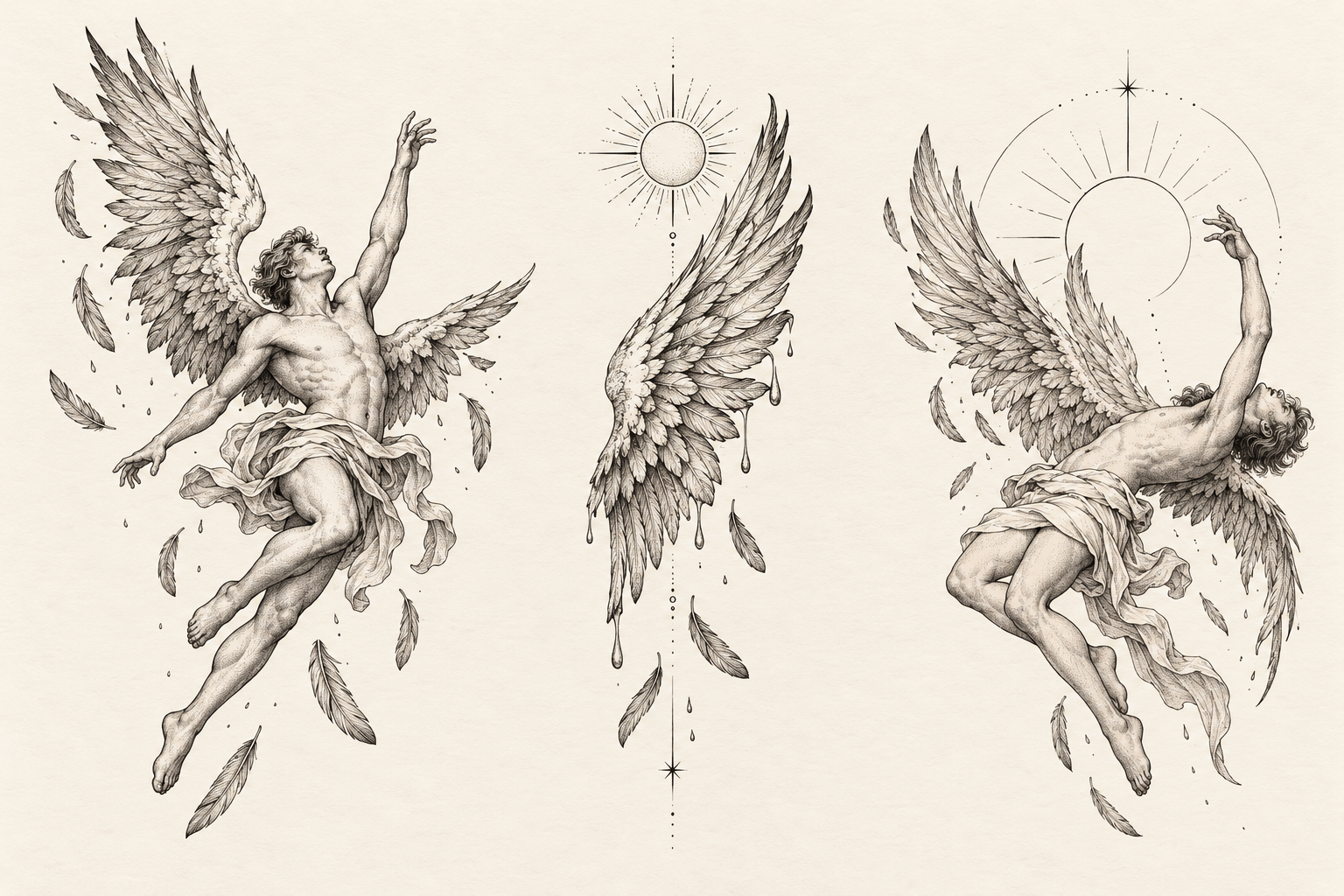
The same winged figure can look triumphant in one sketch and vulnerable in another. Icarus tattoo meaning often comes down to which moment you choose: the possibility of flight, the risk of ignoring limits, the fall, or a father's loss. Ambition is one available reading. Grief and responsibility are others. Reading the story before choosing the pose helps you decide which one belongs in your design. It also keeps a compelling modern interpretation from becoming a false ancient quotation.
The AI-generated cover compares a reaching winged figure, a single wing with droplet forms and loose feathers, and a falling figure with a circular sun motif. These are original concepts, not archaeological evidence or photographs of finished tattoos. The drawn wings are a visual adaptation of the story.
Read the flight and its limits together
In Ovid's Metamorphoses, Book 8, Daedalus builds wings with feathers, twine and wax. He warns Icarus against flying too low or too high: moisture threatens the low route and the sun threatens the high one. Icarus rises, the wax gives way, the feathers separate and he falls into the sea. Daedalus searches and mourns his son.
That short outline supports more than a command to be less ambitious. You may connect with making an escape possible, learning a difficult skill or listening to someone with experience. Another reader may focus on the human cost of a decision. State which part you mean instead of putting every interpretation into one design.
For example, a person beginning an independent project could choose a figure in controlled flight with open space ahead. Someone reflecting on overcommitment might choose a figure losing its wings. Neither choice requires claiming that the myth endorses a modern career lesson. They are personal uses of the narrative.
The Icarus tattoo collection gives you poses to compare. Treat them as starting points for a redraw, with the episode named beside each one.
Three personal meanings lead to different compositions
Ambition and the attraction of flight
If flight is what moves you, show what attracts the figure. An upward hand, a lifted head or clear space above the body can carry that direction without adding a slogan. A visible sun makes the danger more explicit, so decide whether you want that warning in the composition.
A useful brief might be: I want the possibility of leaving confinement to matter more than the crash. Show a complete figure in flight, keep the wings readable and leave out scattered feathers. This remains an Icarus-inspired interpretation even though you have chosen an earlier moment.
Limits and consequences
A falling pose can mark a lesson about limits. Consider what the body is doing: reaching upward, twisting, opening its hands or curling inward. Each changes the emotional emphasis. Loose feathers can suggest the wing's failure, but too many may make the outline hard to follow.
If your meaning concerns balancing effort and rest, you may prefer a stable central figure rather than the most dramatic fall. The story's two-sided warning offers room for that interpretation. You do not have to frame the tattoo as permanent self-punishment for an old mistake.
Grief and the relationship with Daedalus
A father-and-son reading needs room for both people or a clear way to indicate absence. Two figures at different heights, a single separated feather, or an intentionally empty space can become personal design choices. Explain the relationship rather than expecting a viewer to infer it from wings alone.
For a memorial design, compare the memorial tattoo ideas. You may decide that an initial or date carries the private reference more clearly than adding a second detailed body. The story can remain part of your explanation without every episode appearing on the skin.
Avoid details that quietly change the story
Flaming wings are a dramatic addition. In the Ovid passage, the construction fails as the wax softens and the feathers separate; the account does not require the wings to burst into flames. Use fire if you want a deliberate modern reinterpretation, and label it that way.
The popular idea of Icarus laughing as he falls also needs an identified source before it is called ancient. It is not a quotation from the Ovid passage cited here. A sentence found on an unattributed graphic should not become a permanent inscription under a false author credit.
If you want words, write your own short statement or choose a quotation whose text and author you can verify. Use the tattoo font generator to compare letter shapes after confirming the wording. Lettering tools do not establish literary provenance.
A winged man is also not automatically Icarus. Without a named context, it may be read as an angel or a general fantasy figure. You can make the intended narrative more specific through the pose, wing construction or accompanying reference, while accepting that the meaning may remain partly private.
An art reference can suggest a different visual language
MoMA catalogues Henri Matisse's Icarus from Jazz, 1947 as a pochoir print. The museum explains the cut-paper prototypes behind the book's printed plates. Calling that catalogued print an original paper cutout would confuse two stages of the process.
The useful design question is whether your idea needs anatomical detail at all. You might ask for an original simplified silhouette or a more illustrated figure, without reproducing Matisse's composition. The blackwork collection and fine line collection show different ways of organising dark shapes and open space.
For example, an original silhouette with two clearly separated wings could emphasise the body gesture. A shaded figure might let the hands and face carry more emotion. Compare both at the same proposed size so detail alone does not decide the choice for you.
Prepare the pose before choosing the placement
Print or display the whole figure, including hands, feet and wing tips. Mark which direction counts as up. A falling body can become ambiguous when a reference is rotated to fit a narrow area.
For a forearm design, ask how the body follows the arm when relaxed and turned. Keep the wing edges and loose feathers far enough apart to read in the artist's proposed redraw. A digital concept cannot guarantee that every feather will suit the final dimensions.
Bring this short brief: the moment of the fall, reflection on learning limits, one complete figure, two readable wings, a few separating feathers and no attributed quotation. Then ask for an alternate controlled-flight version. Comparing those two drawings will tell you which part of the story you actually want to carry.