
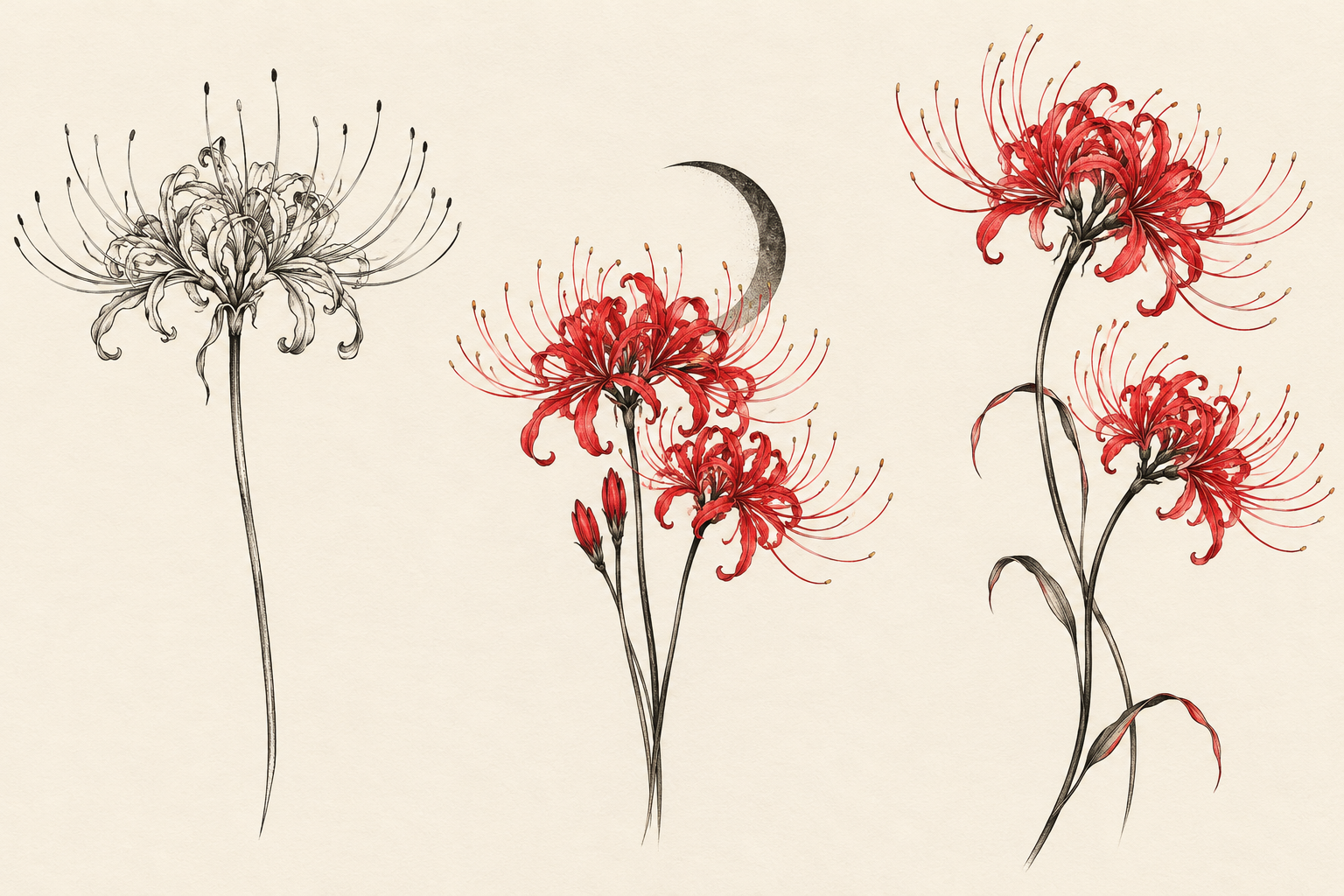
The red spider lily can look fierce while holding a quiet meaning. Spider lily tattoo meaning often involves remembrance, farewell or a personal transition, with part of that interpretation connected to the flower's Japanese autumn setting. It does not predict a death or identify a wearer's loss. You may also choose it for the shape: curled petals, long reaching stamens and a flower head balanced on a spare stem.
There are two decisions to make before adding symbolism. First, identify the plant you want. Then decide which part of its context belongs in your design. A red Lycoris radiata, a black rendering of that plant and a flower borrowed from a fictional scene need different reference notes.
The cover is an AI-generated study of red spider lily layouts. Use it to discuss composition, with a botanical photograph as a separate reference for the flower's structure.
Begin with the red flower's actual context
Japan's National Tourism Organization connects the red spider lilies at Kinchakuda with the autumn equinoctial week and visits to ancestral graves. Its account also describes the flowers as a peaceful, warm sight. That supports a remembrance context without making the flower inherently ominous. See its Kinchakuda red spider lily introduction.
Higan also has a religious meaning that deserves more care than a one-word translation. Myogyoji Temple's explanation of Higan-e describes the other-shore concept in relation to enlightenment and its tradition's memorial offerings for ancestors. Reducing that whole context to a universal realm of the dead loses the distinction.
For a tattoo, this background can support your own connection with remembering someone. It does not make every higanbana design a mourning tattoo, or make the flower unsuitable for someone without a bereavement story. Your reason can be botanical, cultural, personal or a combination.
For example, one stem beside a small private date can be a remembrance composition. The date supplies a particular connection; the flower does not disclose the person's identity or the circumstances of a loss. If you want a separate place for a name, compare the options in the memorial tattoo collection.
Three meanings you can choose, without turning them into rules
Remembering someone
A remembrance design may focus on a person, a place or a season shared with them. You could use a single flower if the memory feels quiet and specific, or a small group if you want the image to evoke a landscape. These are proposed visual choices, not established rules about flower counts.
Ask what detail carries the actual memory. If it is the flower you saw together, its recognizable shape may matter more than a banner saying remembrance. If it is a date, give the date enough separate space to remain readable instead of hiding it among the stamens.
Saying farewell
Farewell can refer to a person, but it can also mark leaving a place or ending a stage of life. A stem leaning away from a small second element may express that separation for you. There is no need to present the composition as a traditional code when you are inventing a personal arrangement.
If you dislike a dramatic mourning tone, describe the mood you do want: calm, spare or gently moving. That gives an artist a useful alternative to surrounding the flower with skulls simply because an online meaning list emphasizes death.
Living through change
You may choose the flower for a transition that is still unfolding. An open, airy composition can leave the meaning less final than a memorial with a fixed date. A small companion shape can also give the plant a different relationship with the rest of the drawing.
A butterfly pairing, for instance, could express change in your own brief. It does not become a universal combined symbol. The butterfly meaning article explains the difference between a biological reference and a chosen metaphor, which is useful when combining two familiar images.
Make sure the drawing is the spider lily you mean
Common plant names can be confusing. For the familiar red higanbana form, identify the reference as Lycoris radiata. Kew recognizes that species in the Amaryllidaceae family in its plant record. Writing the scientific name on your reference sheet helps avoid swapping in a different plant that is also called a spider lily.
NC State Extension's Lycoris radiata description identifies its recurved, wavy flower parts, projecting stamens and flowers on a bare stalk; leaves appear separately in its seasonal cycle. Those features offer a practical drawing check. A broad ordinary lily silhouette or a prominent white central cup can move the design away from the intended red flower.
What to preserve when simplifying
The stamens need room to extend beyond the curled flower parts. If every line is shortened to fit a tiny circle, the head can lose the reaching silhouette that attracted you in the first place. Ask the artist which stems or overlapping lines can be removed while keeping that identity.
You do not need to turn the tattoo into a botanical diagram. The aim is a deliberate simplification of one plant. For example, a single head can use fewer visible overlapping lines while preserving a bare main stalk and several distinct stamens. Mixing unrelated leaves and petals creates a different problem from simplifying detail.
The spider lily design collection compares several original layouts. Treat the drawings as concept options and check the final reference with your artist, particularly if you change the flower color or add foliage.
Red ink, black ink and a flower from a story
Red can keep the connection with the familiar plant visible. Black can emphasize the silhouette and fit more easily with an existing monochrome piece. Neither ink choice establishes a fixed emotional or spiritual meaning. A black spider lily tattoo can carry the same private remembrance as a red one.
For a blackwork design, compare a filled flower mass with a version built around separated lines. Too many dark overlaps can hide the stamens. A neo-traditional interpretation may use stronger contours and a more stylized arrangement; decide which botanical landmarks should survive that treatment.
If your reference comes from anime, record the specific scene or image that matters to you. You can call the proposed tattoo fan-inspired without claiming that the creator assigned one official hidden meaning to every flower appearance. A fictional color or altered flower form should be labeled as a story reference, rather than presented as a verified description of the red plant.
This also helps with a mixed brief. “Red Lycoris radiata with an original layout, inspired by the mood of a scene” gives an artist different instructions from “reproduce this exact fictional flower.” Keep those references separate so a generated image does not quietly blend them into an unintended hybrid.
Match the arrangement to the space
A single upright stem
One stem suits a tall, narrow composition. On the forearm, the stalk can follow the limb while the flower head occupies a wider area near one end. Check whether the stamens cross a curve that makes them hard to see from your preferred angle.
Leave space around the flower head rather than making the stem the only part that fits comfortably. If the head needs to be reduced too far, try changing its angle or using a different location. The plant's proportions can guide the placement choice.
A small group
Two or three heads can create depth through different heights and directions. Their stamens should not all collapse into the same central knot. Ask the artist to show which head leads and where each stalk begins.
A proposed group might have one face-on head and one turned slightly away, with the second lower on the stem line. That creates variation through orientation rather than simply copying and resizing one identical flower. Use the floral style collection to compare how plant-led compositions organize open space.
A flower with another symbol
A butterfly, date or line of personal lettering can share the space, but it needs its own visual job. Put the butterfly where its outline remains separate from the long stamens. Place a date where it reads as text, rather than asking the flower's fine lines to double as numbers.
If the pairing feels crowded, make two versions: flower alone and flower with one companion. Removing an element may clarify the memory you wanted to preserve rather than reduce it.
Questions to take to a consultation
A useful brief could read: “One red Lycoris radiata on a bare stem, for a quiet remembrance. Keep the recurved flower parts and long stamens recognizable. No skull, no invented leaves, and a separate small date. Compare the head facing forward with a slight side angle.”
You can use the tattoo idea generator to explore that comparison. Inspect the generated flower before treating it as a reference; an attractive image can still have merged stalks, misplaced leaves or a flower structure that belongs to another species.
Ask your artist:
- Which features make this clearly Lycoris radiata at the chosen size?
- Can the long stamens stay distinct on this part of my body?
- Does the side view preserve enough of the flower's shape?
- Where can a date sit without competing with the flower head?
- Would one stem communicate the idea more clearly than a group?
There is no need to settle every cultural association before liking the flower. You do need a clear reference and an honest description of your own reason. Bring one botanical image, one preferred composition and one sentence about the memory or transition you want the design to hold.