
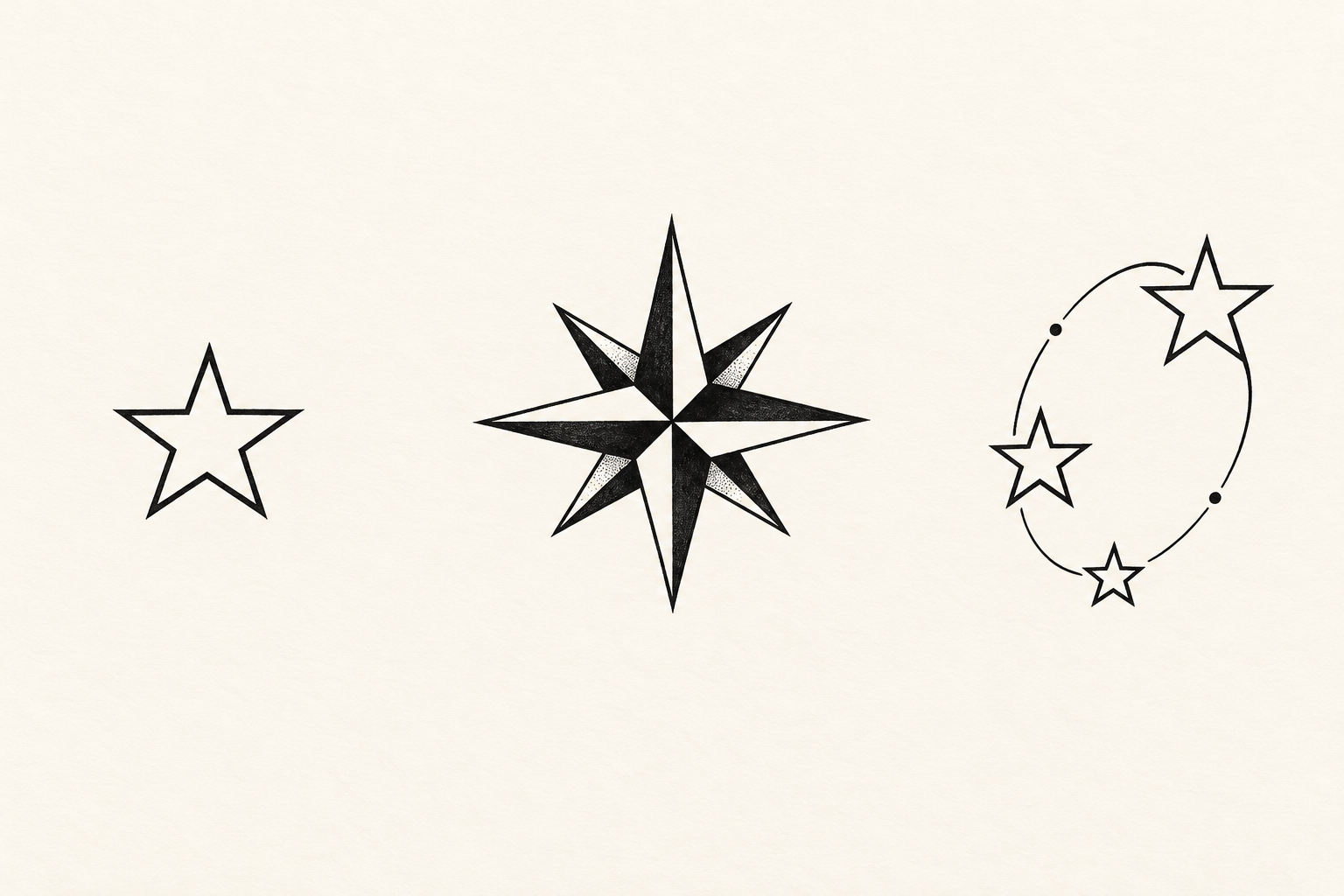
An outlined star, a faceted compass-like star and a streak across the sky can suggest different things. Star tattoo meaning may involve direction, aspiration, remembrance or a moment you want to keep. It can also be as simple as liking the shape. A useful design starts by deciding which star you mean. Then the number of points, arrangement and surrounding marks become practical choices. None of those details can reliably decode a stranger's identity on their own.
The AI-generated cover shows a five-point outline, an eight-point faceted nautical-inspired star, and three stars of different sizes around an open orbit. The drawings are original concepts. They do not map an actual constellation or reproduce a military award, and they are not photographs of finished tattoos.
Guidance begins with a direction you can name
You can use a star as a reminder of a chosen direction. That might be finishing an apprenticeship, staying connected with home or keeping a promise to yourself. A single clearly placed star can carry the idea without a compass rose, map, date and quotation all competing beside it.
For example, someone who has moved away from home might choose one star with a small initial beneath it. The star stands for orientation in that person's story; the initial supplies the private connection. Neither feature establishes an ancient tattoo tradition or a navigational credential.
If you prefer several stars, give the grouping a reason. Three could represent three people when you choose that reading. They could also simply create a rhythm across the composition. A viewer will not necessarily know which applies. For a relationship-based arrangement, the family tattoo collection provides ways to separate individual references without spelling out a complete family history.
A North Star reference has an astronomical basis
The Royal Observatory's Polaris guide explains that Polaris lies close to the north celestial pole and can help locate north. It is the brightest star in Ursa Minor, not the brightest in the entire night sky. This supports a specific astronomical reference; it does not prove that every pointed star tattoo depicts Polaris.
If Polaris is your subject, tell the artist. A stylised star alone may be enough for your personal connection. If you want an actual constellation, bring a labelled astronomical map and identify the stars you want included. Decorative dots around a large star should not be presented as a verified sky chart.
Suppose your theme is keeping a direction during a difficult change. You could ask for one main star above a quiet line, with the line representing your own horizon. That is an original composition inspired by navigation. It does not need a fabricated sailor-origin story to make sense.
Compare sparse and filled shapes in the fine line collection and blackwork collection. An eight-point faceted image offers more internal divisions than a simple outline. Those divisions need room in the redraw.
A shooting star is a different subject
NASA distinguishes a meteoroid in space, a meteor seen during atmospheric entry, and a meteorite that reaches the ground. A shooting star refers to the meteor phenomenon, rather than a star falling from its place in the sky. See NASA's meteors and meteorites explanation.
That distinction can sharpen a personal brief. If you are remembering a brief meeting or an evening watching the sky, a moving streak may feel more appropriate than a stationary star. If you mean steadiness, a North Star-inspired composition may better express your choice.
The trail also controls the image's movement. A long curved trail can guide the eye around a limb, while a short straight streak feels more compact. Ask for both versions before surrounding the motif with more dots. A decorative tail is a design device; it does not have to function as a scientific diagram.
For a remembered night, the memorial tattoo ideas can help you decide whether a date belongs in the design. Keep the date connected to your memory without suggesting that a shooting-star image predicts a future event.
Point counts and emblems need context
Five-point outlines, eight-point faceted stars and other pointed shapes have different visual structures. They can also resemble named emblems used by religions, institutions or communities. Counting points alone cannot establish a wearer's belief, service history or affiliation.
If you deliberately want a particular emblem, identify it by name and consult a source belonging to that context. If you want an original decorative star, tell the artist which references you want to avoid reproducing. Both conversations are more precise than asking what every five-point or six-point tattoo must mean.
A nautical-inspired faceted star can appeal because of its alternating dark and light wedges. You may personally connect it with finding your way. Without an appropriate historical source, do not claim that the exact modern drawing guarantees a specific sailor tradition. Visual inspiration and documented provenance answer different questions.
For example, an artist can redraw eight uneven rays into a balanced original shape, leaving one long axis to follow the placement. That design decision can improve clarity without establishing a new symbolic code.
A small star still needs an intentional layout
A star seems simple until the points become crowded or nearby dots merge into the same visual cluster. Choose the silhouette first. Then compare an outline, a solid shape and a version with open interior divisions at the intended size.
On the wrist, consider how the star appears with the arm relaxed and turned. On the forearm, a group may have more space to establish a direction. Placement can change what is visible; it does not impose a different personal meaning.
If several stars represent people, decide how equal or unequal you want them to look. Making one star larger may suggest emphasis even when you did not intend a hierarchy. A simple paper comparison helps you notice that before adding lettering.
A practical brief could read: three original outline stars for three siblings, equal visual weight, no constellation claim, generous gaps, no attached initials in the first sketch. Compare it with one main star and two smaller ones. Your reaction to the two arrangements will reveal which relationship you actually want the drawing to express.
Keep the explanation as specific as the image
Try completing the sentence: I chose this star because it reminds me of this person, place or commitment. If you prefer the shape without a symbolic story, that is also a clear answer.
Bring the selected star type, an intended size and one arrangement to the artist. Keep an astronomy map only if the sky reference matters. Leave out point-count interpretations that you cannot connect to your own design, and let the final sketch carry the story you have actually chosen.