
A low swell and a breaking wave create very different moods. Wave tattoo meaning can involve change, persistence, a place by the sea or a private memory of the water. The choice does not require a storm or a story about overcoming everything. A quiet wave may fit your experience better. Decide what kind of water belongs in the image, then choose the scale, foam and surrounding details that support it. If a famous print is your reference, name it accurately.
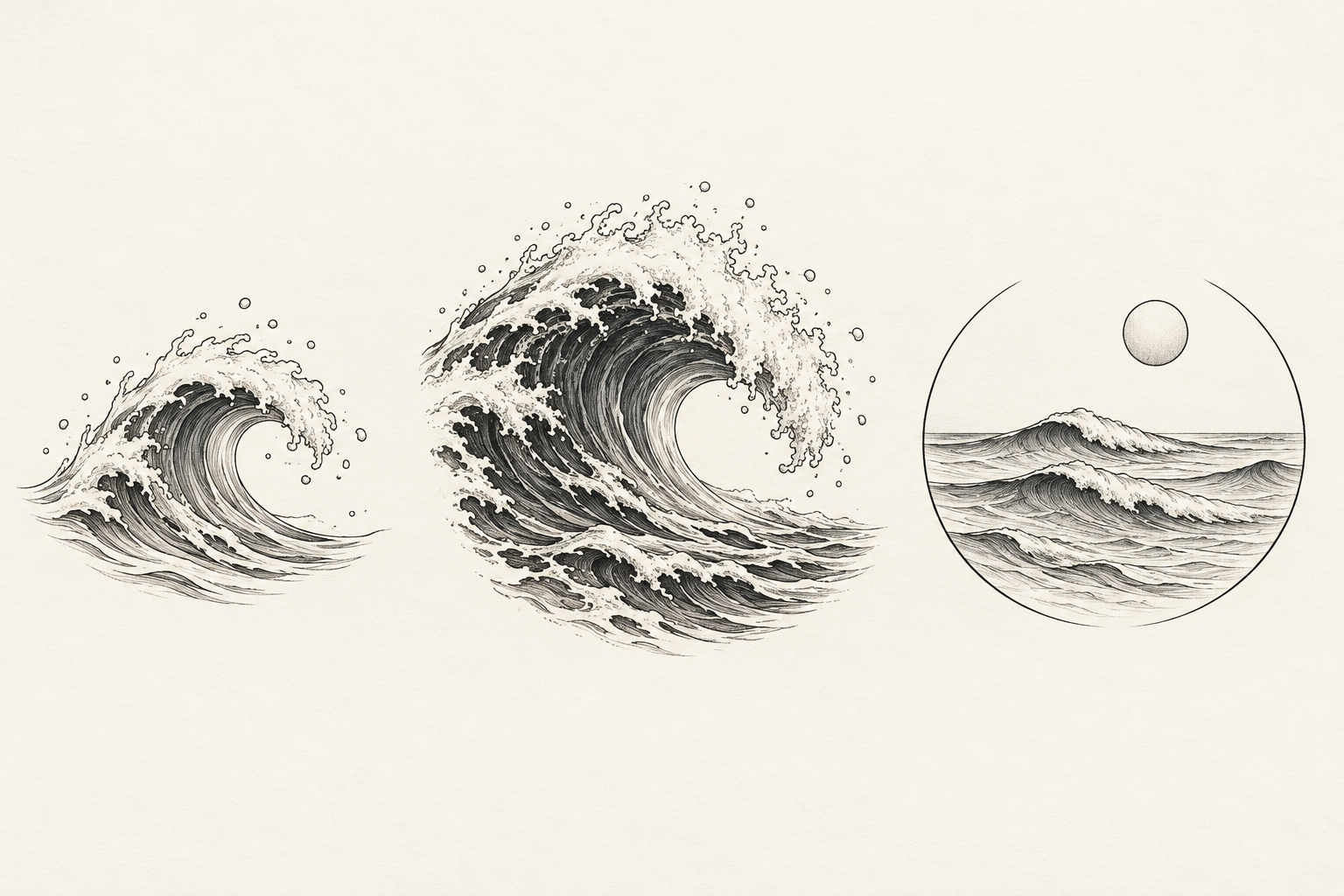
The AI-generated cover compares a compact curling wave, a larger breaking wave and layered swells within a partial circle beneath a small sun disc. These are original illustrative concepts. They do not reproduce Hokusai's print or show photographed tattoos.
Change and persistence are personal readings
A wave can become a useful reminder that circumstances change. Give that thought a specific connection: returning to a coastal hometown, leaving a job, or adjusting to a new routine. The personal event makes the design more precise than a long list of freedom, strength and eternity.
For example, someone remembering early-morning walks by the sea might want a low horizon and one gentle swell. That image could represent consistency or time to think. Another person may prefer a curling breaker because it recalls learning to surf. Both are legitimate personal stories, with different visual requirements.
A physical fact can inspire a metaphor without proving it. NOAA's explanation of ocean waves describes energy passing through water and notes that wind commonly creates surface waves. It does not establish a psychological effect or a fixed tattoo meaning. Keep that distinction when connecting motion in water with change in your own life.
Browse the tattoo ideas hub if you are still comparing an ocean image with other subjects. You may find that one wave is enough, without filling it with every animal, instrument and memory associated with the sea.
A sea memory works best with one recognisable detail
If the tattoo records a place, identify what you remember most clearly. A flat evening horizon, a repeated line of surf or a particular rock outline can provide a visual anchor. A generic large wave may not capture the scene you actually want.
Bring a reference you can use and separate the essential detail from the scenery around it. You might keep the shoreline curve and remove distant buildings. Or keep the wave's direction and omit the beach entirely. The artist needs to know what makes that place yours.
For remembrance, a small initial or date can sit outside the water rather than being forced into foam. Compare memorial tattoo ideas and initial tattoo ideas if the personal reference needs its own space. A clear date can hold the private story while the wave remains visually simple.
This approach also helps with a shared design. Two people who remember the same beach can choose different line treatments while keeping the same shoreline. Sharing a memory does not require identical drawings.
Hokusai's Great Wave is a named artwork
The Met dates Katsushika Hokusai's Under the Wave off Kanagawa to about 1830–32. The woodblock print belongs to Thirty-six Views of Mount Fuji. The museum notes the small distant Mount Fuji within the composition and its indigo and Prussian-blue palette.
If that print is your reference, say so. Its relationship between the large foreground wave and distant mountain matters. Removing the boats, mountain and spatial relationships can produce a new composition, which should be described as an adaptation rather than an exact reproduction.
Every curling wave is not automatically a Hokusai reference. The cover here deliberately uses original wave arrangements. Likewise, the presence of a large crest does not by itself establish that an image depicts a tsunami. Avoid adding a disaster identity merely to make the design sound more dramatic.
For a Hokusai-inspired brief, identify the elements that matter to you: the contrast in scale, the mountain's position or the wave's rhythm. Ask for an original redraw appropriate to the intended space. A small tattoo may not support every boat, foam tip and internal line from a densely structured print.
The Japanese tattoo style collection can help you compare broader visual approaches. It does not make every ocean drawing a historically authenticated Japanese design.
Choose between a quiet swell and a breaking wave
One minimal line
A simple curl or low swell keeps the silhouette compact. It can suit a private reminder of a place or routine. With fewer details, the artist's choices about curve and spacing become especially visible.
Ask for two versions with different crest heights. A low curve may feel calm; a taller curl may look more active. These are visual impressions you can compare, rather than universal symbolic rules. The fine line collection provides examples of restrained detail and open space.
A breaking crest
A larger breaker gives the foam and hollow more prominence. It can support a personal story about energy, a sport or a powerful sea memory. Decide how much of the base needs to remain visible so the wave does not become an isolated hook.
For example, you might ask for a clear hollow, a short trailing base and only a few detached drops. That gives the artist an intelligible structure. More spray is not automatically more expressive, particularly when it hides the outer contour.
Several layered swells
Layered water can suggest distance and repetition. A partial circle or horizon can organise the scene without turning it into a complete landscape. Decide whether a sun, moon or coastline adds information you want.
If three lines represent three stages of your life, state that as your own interpretation. The number does not establish a historical code. The image should still work as water when the explanation is private.
Keep cultural labels tied to identifiable references
A wave shape alone cannot justify a generic claim about all Polynesian traditions or any other broad group of cultures. If a reference belongs to a specific practice or community, identify it and seek informed guidance about that particular context.
An original ocean drawing can also remain an original ocean drawing. You can choose its curves because you like them and attach your own sea memory. No borrowed cultural label is necessary to give a personal design value.
Prepare a brief with movement and scale
Write the scene, personal connection and required details. A useful example is: a low ocean swell for morning walks with my father, one horizon line, no boats or famous-print imitation, with a small initial kept separate. Prepare a second version without the initial to compare the balance.
For the forearm, ask how the horizontal motion follows the arm. For the wrist, compare a simplified crest at the proposed size before retaining small droplets. Let the artist review spacing and placement on the body.
Choose one wave arrangement and one reference that explains your memory. That is enough material for a focused conversation about the drawing you want.