A complete sword and a broken blade can point toward very different stories. Sword tattoo meaning may involve courage, protection, justice, discipline or the decision to end a conflict. The object does not choose among those meanings for you. A ceremonial sword, a fictional weapon and a blade from a museum reference also carry different contexts. Before choosing a flower or a dramatic angle, decide what you want the sword to do in the image. That decision will help an artist draw something more specific than a generic emblem of strength.
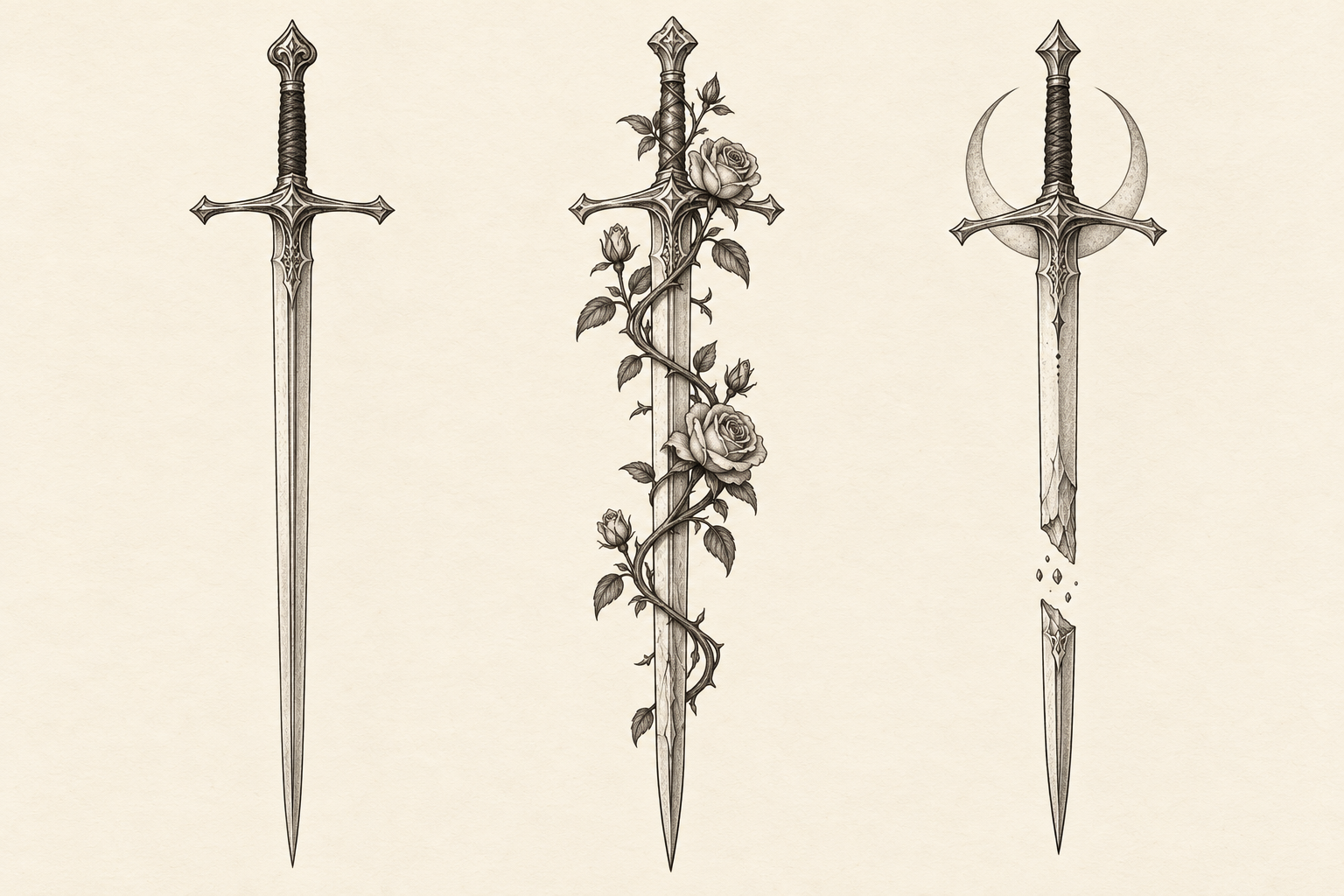
The AI-generated cover compares a complete straight sword, a sword with a flowering rose vine, and a broken sword with a crescent behind the guard. These are concept illustrations, not historical object records or photographs of healed tattoos.
Give the blade a role before choosing its decoration
Courage can be a personal reading when the sword represents facing a difficult task. Someone returning to study after a long interruption might choose a clean, intact blade as a private reminder of resolve. That person does not need to identify as a warrior or suggest that the tattoo records combat experience.
Protection becomes more precise when you name what matters to you. Defending your time, caring for a sibling and keeping a promise are different commitments. A sword beside a small initial could carry one of those stories, provided you choose it. The initial will not make the meaning obvious to everyone, and privacy may be part of the appeal.
Restraint offers an alternative to a permanently confrontational image. A sheathed sword might represent readiness without action. A blade at rest could mark your decision to stop treating every disagreement as a fight. Those are proposed personal interpretations, not historical definitions of all sheathed or downward-pointing swords.
Write the action in ordinary language before translating it into a visual symbol. I want to defend my boundaries is more useful than strength, power, honour, courage and destiny together. If an initial belongs in the composition, compare initial tattoo ideas and decide whether it needs its own quiet space beside the weapon.
A documented example: authority, justice and mercy
British coronation regalia provide a concrete example of swords holding different assigned roles within one ceremony. The Royal Household describes the Sword of State as representing royal authority. It distinguishes swords associated with Temporal Justice and Spiritual Justice, and identifies Curtana as the Sword of Mercy, whose blunted tip represents mercy. See The Coronation Regalia for the ceremonial context.
The useful lesson for a tattoo is that a blade's meaning can depend on its particular form and setting. A sword is not automatically an endorsement of violence. Equally, choosing a sword tattoo does not make your design part of that coronation tradition. If mercy is your intended theme, discuss how to show restraint in your own composition without claiming to reproduce a historic regalia object.
For example, you might prefer an intact blade with a quiet, symmetrical hilt because it feels composed. Another person may want a visibly softened or blunted tip to express the same value more directly. A shortened point can also look accidental if the intention is unclear. Bring a reference and explain the choice so the artist can handle it deliberately.
Do not turn this one ceremony into a rule that every sword represents justice. Historical examples are most useful when they keep their names, places and limits. Your personal design can borrow an idea without borrowing an unsupported ancestry.
Match the type of sword to your actual reference
A straight, double-edged blade with a crossguard gives a different silhouette from a curved Japanese sword. A short dagger is another object again. If your attachment comes from a book, a family object or a museum visit, the shape is part of what makes the reference recognizable. Calling all of these weapons a sword can conceal choices the artist needs to understand.
The Metropolitan Museum of Art's mounted samurai armour record identifies a tachi, or slung sword, with an officer's armour associated with the Mōri family. That specific record is a useful reminder that a Japanese sword reference need not be a katana. It does not justify identifying every curved blade from a thumbnail image.
If you want a Japanese sword, bring an object record or a clear reference and ask the artist which details belong to that type. A generic list of discipline, loyalty and honour cannot replace knowing which weapon you have selected. The tattoo style collection can help you compare visual treatments, while a museum reference helps with the object's identity. Those resources answer different questions.
A fictional sword calls for another kind of accuracy. You might care about a distinctive guard or a particular break in the blade more than realistic construction. Explain which features connect you to the story and ask for an original composition around them. A fantasy weapon should not be presented as an authentic historical design merely because it looks old.
Whole, crossed or broken: how the arrangement changes the reading
One complete sword
A single sword provides a clear centreline. It can feel resolved, formal or spare depending on the hilt and surrounding space. For a personal commitment, that simplicity may keep the focus on the promise rather than on a dramatic scene.
Suppose you want a reminder to finish a long training programme. A complete blade with one small date below the pommel may express that idea more clearly than a sword surrounded by flames, wings and a crown. The date still needs room to be legible at the chosen size. Ask the artist to compare a version without text before deciding.
Two crossed swords
Crossed swords introduce a second blade and a strong central overlap. You might use that arrangement for two commitments or a shared interest in historical fencing. The design alone does not establish membership in a military group, a rank or an achievement.
Keep the crossing point readable. If both guards, grips and blade edges crowd the same small area, viewers may struggle to tell where one weapon ends. An artist can adjust the angle or reduce decoration so the pair remains distinct. A shared-story design might also work as two separate tattoos instead of one crowded emblem.
A broken sword
A broken sword tattoo can express an ending, refusal, loss or survival if that is what you choose. Someone leaving a hostile situation might read the break as the end of a conflict. Another person could connect it with a fictional character or a goal they have deliberately set aside. A break does not always mean defeat.
Specify what happens to the detached piece. In the cover study, a narrow gap separates the lower section from the rest of the blade. Keeping that piece aligned makes the interruption a focal point. Scattering fragments would create a more forceful mood. Neither layout has a fixed psychological meaning, so describe the feeling you want instead of relying on a symbolism list.
Flowers, hearts and snakes add another subject
A sword with a rose
A rose can bring affection, remembrance or a particular person into a blade composition when you give it that role. You might use a living vine wrapping around an intact sword to hold tenderness and resolve in the same drawing. That is a design proposal, not a universal definition of a sword-and-rose tattoo.
Decide whether the rose is beside the blade, wrapped around it or pierced by it. A bloom resting near the guard suggests a different relationship from a visibly pierced flower. Browse rose tattoo examples for flower shapes, then ask your artist to preserve the separation between the stem and the sword. Tangled outlines can obscure the detail that carries your story.
A sword and a heart
A heart near a sword could represent commitment, heartbreak or protecting someone you love. A heart split by a blade will invite a sharper reading than a heart placed beside a sheathed weapon. If your intention is care, examine whether the composition shows the relationship you actually want.
For a family-related piece, one blade and a separate small heart may be enough. The family tattoo collection offers other ways to represent connection if a pierced heart feels too severe. Changing the relationship between the objects can be more effective than adding an explanatory sentence underneath.
A sword with a snake
A snake introduces movement and another possible personal meaning, such as change or vigilance. Start by deciding whether it coils around the weapon, moves past it or faces the blade. A calm coil and an open-mouthed confrontation will create very different scenes.
Avoid assuming the combination is automatically a medical symbol. The exact object, number of snakes and surrounding context matter when discussing a named emblem. If you intend to reference your profession, take that profession's actual symbol to the artist and verify its identity. A decorative sword-and-snake design does not require a professional claim.
Direction and placement have no universal dictionary
A blade pointing upward is not a reliable statement about victory, and a downward blade does not prove grief or defeat. Particular traditions may use directions deliberately, but a general tattoo cannot inherit every such convention. On a moving arm, the same drawing also changes its angle repeatedly.
For a long blade, compare forearm placements with the broader space in upper-arm designs. Try a paper outline at the size you are considering. Check the pommel and point with the arm relaxed and bent, and decide which details you want visible from the front.
A straight sword makes small alignment changes easy to notice. Ask your artist to assess the stencil on your body rather than making the blade perfectly vertical in one photograph. For a broken sword, check that the intended gap remains visible in the position where you will usually see it. None of these checks predicts pain or healing; they help you discuss the composition.
Turn the meaning into a usable artist brief
Choose one role, one blade reference and one essential detail. A useful brief might read: A complete straight sword for keeping a promise to myself, with a plain crossguard and one rose beside the grip, leaving the blade clear. It explains both the story and the arrangement without asking the artist to illustrate six abstract values.
Compare one restrained alternative before adding more symbols. The tattoo idea generator can help you explore a plain sword against a rose composition as concept art. Inspect generated blades for crooked edges, merged guards, extra grips and impossible overlaps. Your artist should redraw the final version for the intended placement.
Bring the reference, desired physical size and your short explanation to the consultation. Ask which detail needs more room and which one could be removed without losing the story. Sword tattoo meaning becomes personal through those choices. An identifiable blade doing one clear job usually gives you a better conversation than a borrowed claim about what every sword must represent.