
An enormous fish covered in pale spots offers a different starting point from a snarling shark. Whale shark tattoo meaning often begins with a person's connection to the ocean, a memorable encounter or an idea of strength expressed quietly. Those are personal interpretations. The animal does not carry one universal message for everyone who draws it. If you want a design that feels connected to this particular species, its broad head, spotted back and swimming shape give you more useful direction than a list of borrowed spiritual claims. Start with the animal, then decide which part of your story belongs beside it.
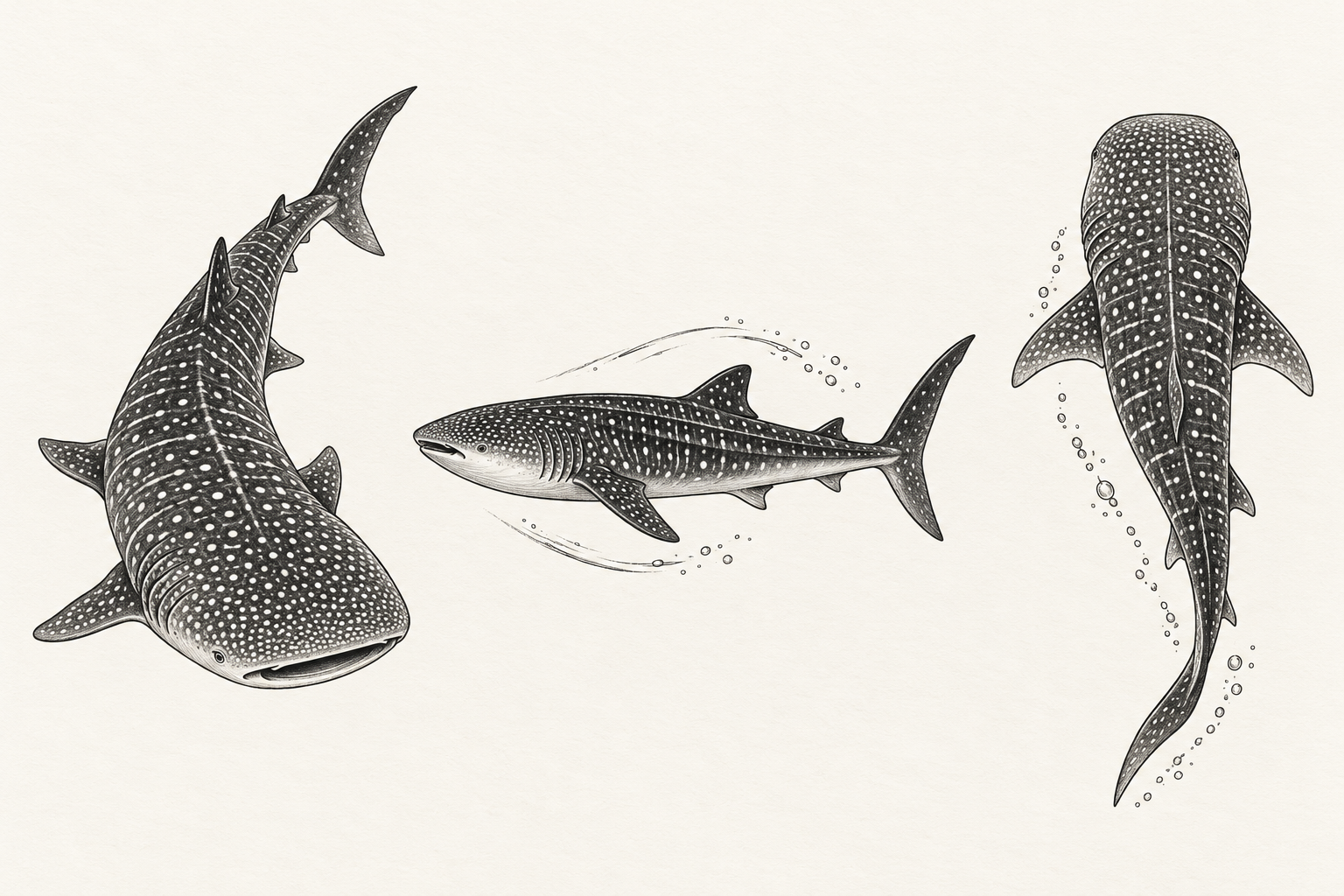
The AI-generated cover shows three complete whale shark studies: a three-quarter view from above, a side view with loose water arcs, and an overhead view with a bubble trail. They are concept illustrations for design discussion, not photographs of wildlife or tattoos on skin.
What a whale shark tattoo can mean to you
Quiet strength is a reasonable personal metaphor for someone drawn to the animal's scale and filter-feeding behaviour. You might choose a calm swimming pose to mark a change in how you handle pressure. That connection comes from your experience; biology does not establish a human personality trait or promise an emotional effect from a tattoo.
An ocean memory can be more specific. Perhaps you saw a whale shark from a boat, watched one in an aquarium or first became interested in marine life through a childhood book. The image can record that encounter without implying that you have dived alongside the species. Be precise about which memory you want to keep.
Individuality is another possible reading, prompted by the animal's spot pattern. You may like the idea of a recognizable animal made distinctive by its markings. A tattoo with an invented pattern can express that metaphor, while a tribute to a particular observed shark would need a suitable photographic reference.
For example, a parent and adult child might choose different swimming views after a shared aquarium visit. Their connection would come from the visit and the animal, not from identical dot counts. If you are comparing ways to record a shared experience, browse the family tattoo ideas and decide whether a second symbol adds anything useful.
Identify the animal before assigning the symbolism
Despite its name, the whale shark is a shark and a fish. Georgia Aquarium identifies it as Rhincodon typus and describes a broad, flat head, a mouth at the front, pale spots on a darker back and filter feeding. These details help distinguish a whale shark design from a generic shark or whale. See the aquarium's species account for the animal reference.
In a tattoo brief, preserve the features you need for recognition. A very pointed snout, a large display of predatory teeth or whale-like horizontal flukes could pull the drawing toward a different animal. A stylized design can simplify anatomy, but it should simplify the intended species deliberately.
Compare two hypothetical thumbnails. The first is a dark streamlined shape with a pointed head and no visible pattern. The second has a broader front, readable fins and a few separated pale spots. If identifying the whale shark matters to you, the second gives an artist clearer information even though it may contain fewer drawn marks overall.
When comparing simplified designs in the tattoo style collection, keep a thoughtful animal reference beside them. Minimal does not have to mean anonymous. Ask the artist which outline features identify the species before deciding which details can be removed.
Gentle strength is a metaphor you can shape
A whale shark design can hold visual weight without an attack pose. A complete animal moving through open space may support the feeling of steadiness you want. A tight curve, a strong diagonal and a densely shaded body will each create a different mood. These are composition choices; they do not prove what the animal is thinking.
Suppose you want a reminder to stay measured during demanding work. You could ask for a broad, unhurried-looking swimming silhouette with room around the head and tail. Adding a storm, a ship and several competing sea animals might shift the focus toward struggle. If quiet presence is your priority, you can leave those elements out.
Another person may want the same species to remember the first time the open sea felt exciting rather than intimidating. An upward curve and a little more movement might fit that story. The two tattoos could both connect with strength while needing different arrangements. Give your artist the feeling and the specific memory, then compare visual responses.
A fine-line treatment can make the outline and selected markings prominent. A blackwork approach can concentrate attention on the body shape and the pale spaces reserved for spots. Neither technique guarantees a calmer or more meaningful result. Use them to compare how clearly the animal reads at the size you want.
Spots: personal identity, decoration or a specific encounter
Georgia Aquarium describes individual spot patterns as differing between whale sharks. That observation gives an individuality metaphor a factual starting point. The metaphor remains your interpretation, and an illustrative dot pattern should not be presented as a record of a named animal.
There are three useful ways to handle the markings. You can use a simplified decorative pattern, select a reference from an actual encounter, or work with the artist on a restrained arrangement that makes the species clear without reproducing every spot. Name the approach in the brief so the artist knows which marks are essential.
If a particular shark matters to you, check whether the photograph shows the relevant side clearly. An overhead picture and a distant side view do not offer the same information. Use an image you have permission to use, and ask the artist to explain any simplification. A sentimental connection does not require claiming that every visible spot has been copied exactly.
For a purely personal design, you might leave a little open space near the animal for a small initial. The initial tattoo collection provides ways to compare lettering separately. Avoid turning the whole spot field into tiny letters if that would weaken the animal's identity. The person and the shark can share a composition without occupying the same marks.
A conservation connection with a concrete basis
The aquarium's species page lists the whale shark as Endangered on the IUCN Red List. That makes conservation a relevant subject for someone who wants their tattoo to prompt informed conversation. It does not make the image itself a conservation action, and a tattoo is not evidence that its wearer supports a particular organization.
A recent example offers a more specific conversation. In its April 30, 2026 announcement, study partner Conservation International reports research tracking 70 whale sharks and movements spanning 13 countries and territories and the high seas. The study announcement emphasizes the need to protect connected habitats. Those figures describe that reported study, not every whale shark's route.
If that idea matters to you, an open swimming composition could represent your interest in connected ocean spaces. A line behind the fish might be a personal visual suggestion of movement. Label it as an imagined route unless you have actual tracking data and permission to use it. A decorative curve should not accidentally become a claimed scientific map.
You could pair the design process with a separate practical step, such as reading the research announcement or choosing a marine conservation project to learn about. Keep any statement about donations or partnerships tied to something you actually do. The drawing can start a conversation without carrying a claim it cannot support.
Choose the view that fits your story
Overhead: the patterned back becomes the subject
An overhead view gives the broad head, fins and spotted back room to work together. It may suit someone whose strongest memory is looking down from a boat or watching an animal swim below them. The cover's right-hand study provides a full-body example, with the tail visible and a curved bubble trail beside it.
Ask how much surrounding space the silhouette needs. If a wave, compass and date all sit beside the same small head, the species can become a background detail. One clear fish with a small personal addition may hold the memory more directly.
Side view: movement and body length
A side view emphasizes the animal's length and tail. It can be useful for a design that follows an elongated area, such as the forearm. In the cover, loose arcs sit around the central animal without enclosing it in a heavy frame.
Check which fins remain visible and how the spots relate to the side of the body. A simplified side view still needs a recognizable head. If a draft looks like a generic shark with dots added afterward, return to the animal reference before adding more ocean decoration.
Three-quarter view: a more dimensional encounter
A three-quarter view lets the head and patterned back appear together, with the body turning away. It can evoke the feeling of observing an animal pass, if that suits your own memory. The cover's left-hand study uses this view, keeping the complete tail inside the composition.
Perspective introduces more drawing decisions than a flat silhouette. Ask the artist to check the relationship between the near fin, far fin and tail. A digital concept can contain convincing texture while still distorting those relationships. Treat it as a prompt for discussion, not a final stencil.
Placement, scale and a useful consultation brief
Decide which feature must remain readable first: the whole silhouette, the broad head or the spot pattern. For a small design, preserving all three in equal detail may require simplification. For a broader composition, the shoulder placement examples can help you compare how much space you want to use, before your artist adapts the drawing to your body.
Try the preferred view at two physical sizes. Look at it from ordinary conversational distance and check whether the fins and tail remain separate. If the spot pattern dominates the outline, ask about fewer, more distinct marks. That discussion is more useful than choosing a size from an enlarged phone image.
A workable brief could read: A complete whale shark seen from above, for the aquarium visit I shared with my father, with a clear broad head, separated pale spots and no extra animals. Add the intended placement and an approximate size. If the memory is private, you can omit a name or date and still give the artist enough direction.
Use the tattoo idea generator to compare views as concept art if you want another starting point. Check each generated animal for extra fins, merged tails and a mouth that belongs to another species. Your tattoo artist should redraw and assess the final version. Whale shark tattoo meaning becomes most convincing when the animal is recognizable and the personal story is one you can comfortably own.